
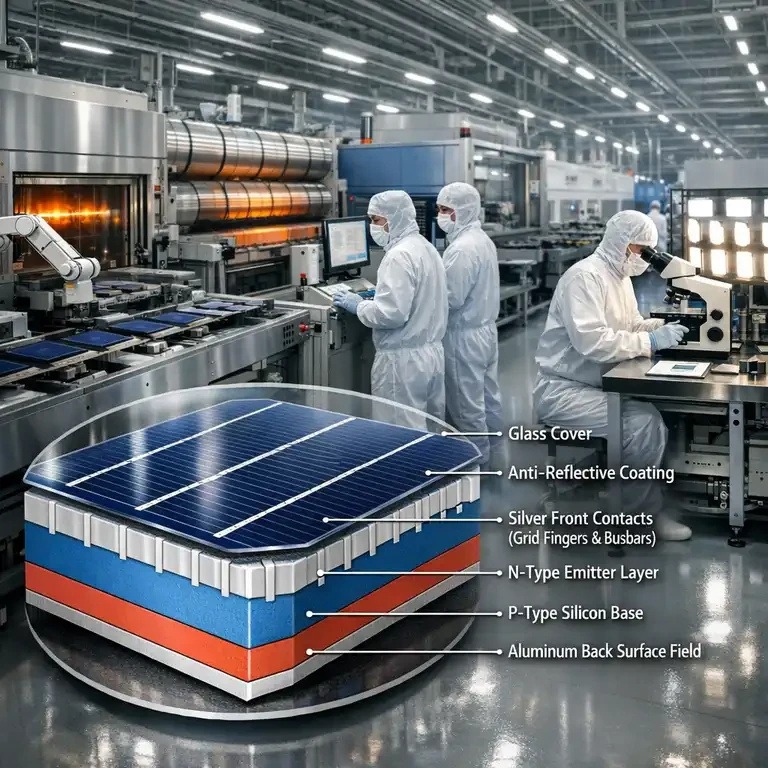
Solar panels are the main components of photovoltaic power plants, responsible for converting sunlight into electrical energy. These panels consist of multiple solar cells made using semiconductor materials and advanced manufacturing technologies. The production process of solar cells and their assembly into usable solar panels involves several precise industrial stages. This article examines the steps involved in manufacturing solar cells and producing solar panels.
Raw Material for Solar‑Cell Production
The most important raw material used in solar‑cell manufacturing is silicon. Silicon is one of the most abundant elements in the Earth’s crust and is widely used in the photovoltaic industry due to its suitable semiconductor properties.
The production process begins with extracting silicon from silica rock (SiO₂). In silicon‑production facilities, the material is purified in extremely high‑temperature furnaces until high‑purity silicon is obtained. For solar‑cell manufacturing, silicon must reach very high purity levels, as impurities can reduce the electrical performance of the cell.
Production of Silicon Ingots
After purification, the silicon is melted and poured into special molds to form silicon ingots. Depending on the technology used, these ingots fall into two main categories:
- Monocrystalline ingots
- Polycrystalline ingots
In monocrystalline production, the silicon crystal structure is uniform, resulting in higher solar‑cell efficiency. In contrast, polycrystalline cells are composed of multiple crystal grains and have lower production costs.
Cutting Silicon Wafers
In the next stage, silicon ingots are precisely cut into thin wafers using specialized slicing machines. The thickness of these wafers is typically around 150–200 micrometers.
Wafers serve as the base structure for manufacturing solar cells, and their surface quality has a direct impact on the final performance of the cell. Therefore, strict quality control is performed during this step.
Creating the Semiconductor Layer and Electrical Junction
To transform a silicon wafer into an active solar cell, a PN junction must be created within it. This is achieved by adding very small amounts of elements such as phosphorus or boron. This process, known as doping, creates an internal electric field inside the cell.
When sunlight hits the surface of the solar cell, this electric field causes electrons to move, generating electrical current.
Next, an anti‑reflective coating is applied to the cell surface to increase light absorption. Then, extremely thin metallic grid lines are printed onto the cell to collect and transfer the electrical current.
Assembling Cells into a Solar Panel
Once solar cells are produced, the assembly process for creating a solar panel (solar module) begins. In this step, cells are connected in series and parallel arrangements to achieve the desired voltage and power output.
The cells are then sandwiched between multiple protective layers, typically including:
- Impact‑resistant glass on the top
- EVA (ethylene‑vinyl acetate) encapsulation layer
- Protective backsheet layer
- Aluminum frame for mechanical strength
These layers are bonded together under high temperature and pressure using laminating machines. This process, called lamination, ensures the panel’s resistance to moisture, dust, and environmental conditions.
Installing the Junction Box and Final Testing
In the final stage, a junction box is installed on the back of the panel. The junction box transfers the electrical current generated by the cells to the output cables.
After assembly, the solar panels undergo various tests to verify their quality and performance. These tests include measuring output power, checking environmental resistance, and performing electrical‑safety evaluations.
Conclusion
The production of solar cells and photovoltaic panels is a complex and precise industrial process that begins with silicon purification and ends with assembling durable and efficient solar modules. Advances in solar‑cell technology have led to higher efficiency, lower production costs, and accelerated global development of solar‑power plants. As demand for renewable energy continues to rise, solar‑panel manufacturing is set to remain one of the most important sectors in the future of the energy industry.
