
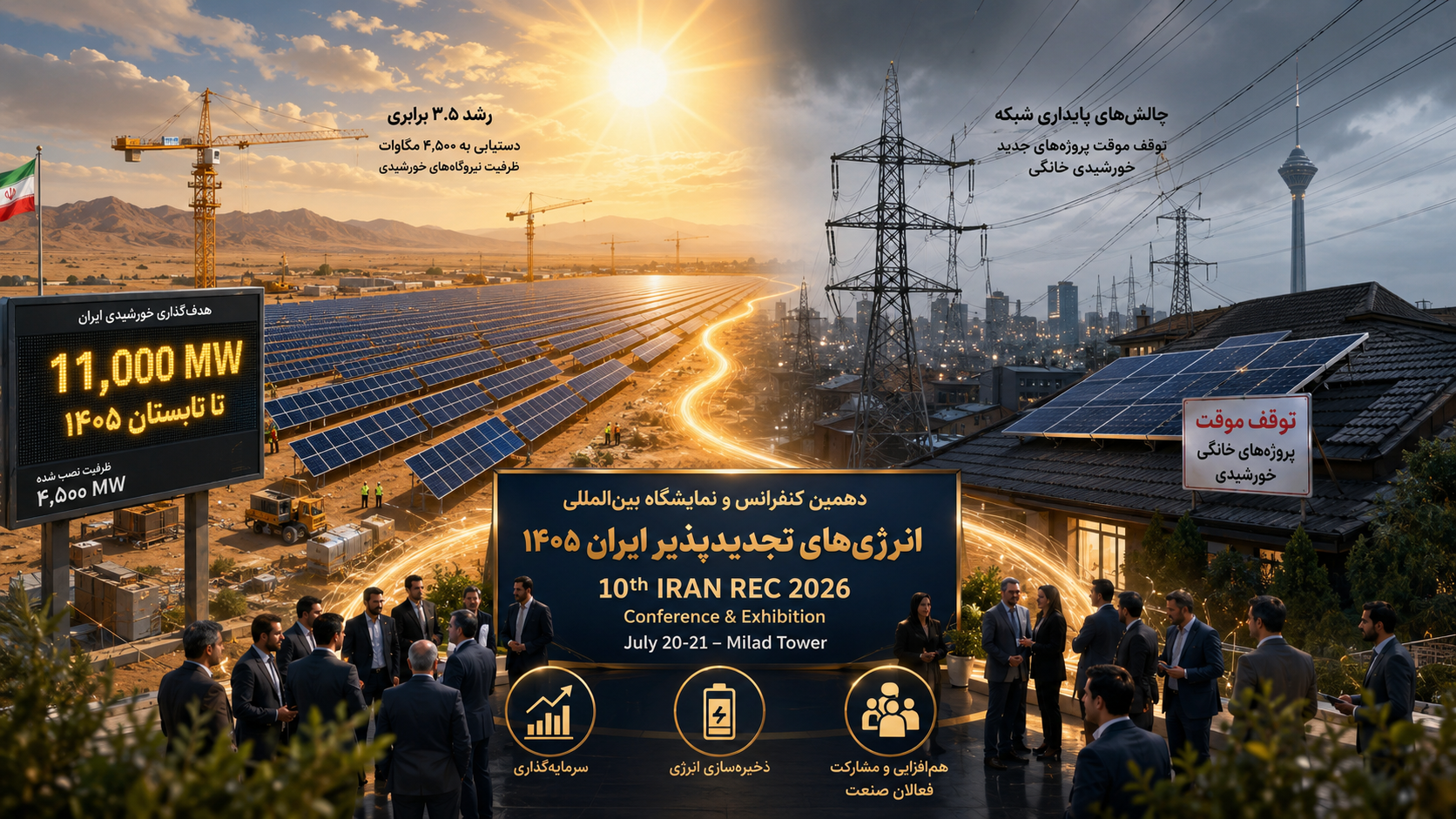
Iran’s solar energy industry has recently been met with two significant news items that paint a picture of maturity and growing complexity in this field. On one hand, official statistics indicate an unprecedented leap in renewable energy capacity and ambitious plans for further development. On the other hand, concerning news has emerged about the temporary suspension of residential solar power plant projects due to grid instability. These two simultaneous events show that Iran’s solar industry has moved beyond the phase of “mere accelerated growth” and entered a stage of “intelligent and sustainable development”—a stage in which, alongside quantitative capacity increases, attention is also paid to grid stability, technical integration, and policy maturity. Meanwhile, the 10th International Renewable Energy Conference and Exhibition of Iran (IRAN REC 2026), scheduled for July 20–21 at the Milad Tower in Tehran, provides a suitable platform for examining these developments and charting the future path.
The latest official figures show significant growth in the country’s renewable energy capacity. According to the Deputy for Technical and Engineering Affairs of the Renewable Energy and Energy Efficiency Organization (SATBA), the country’s renewable energy capacity has increased 3.5-fold since the beginning of the 14th administration, rising from 1,200 MW to 4,500 MW. This leap results from connecting 3,000 MW of solar power plants to the grid last year, with plans to install another 2,500 MW in the first quarter of the current year (starting March 21, 2026). The ultimate goal of this program is to reach 11,000 MW capacity by the end of summer and increase the share of renewables to over 10% of the country’s energy mix during this administration. These figures show that Iran’s solar industry is expanding at an unprecedented pace, with development plans now defined beyond previous targets of 30,000 MW by the end of the 14th government.
However, this rapid growth has also brought new challenges. One of the most significant is “grid instability” caused by the rapid increase in distributed solar generation. Recently, news emerged that SATBA had temporarily suspended acceptance of new applications for rooftop residential solar power plants due to concerns over grid instability. This temporary measure indicates that the country’s electricity grid infrastructure needs greater maturity and intelligence to absorb and manage the massive volume of distributed generation, which is intermittent and unpredictable by nature. A similar experience has been observed in European countries, where rapid solar growth has challenged aging grids. This issue highlights more than ever the need for simultaneous investment in modernizing and smartening electricity distribution and transmission networks. Alongside this, news has also been published about facilitating conditions for receiving bank facilities for residential solar power plants, including the requirement to open an account with Bank Mellat and having a suitable credit rating, showing that support mechanisms are evolving and being regulated.
In such a situation, where Iran’s solar industry is experiencing both unprecedented growth and the challenges of maturity, the 10th International Renewable Energy Conference and Exhibition of Iran (IRAN REC 2026) is considered a key and path-breaking event. This event, scheduled for July 20–21, 2026, at the Milad Tower International Conference Center in Tehran, is designed to create a specialized platform for interaction among policymakers, industries, investors, knowledge-based companies, and the academic community. The main themes of this event reflect the maturity of the industry: green electricity market development, requirements and opportunities arising from Article 16 of the Law on the Leap in Knowledge-Based Production, the role of industries in developing renewable power plants, energy storage technologies, project financing, and localization of modern technologies. These themes are precisely the issues that currently appear vital for continuing the growth trajectory of Iran’s solar industry. For example, the discussion on “energy storage technologies” could offer a solution to the challenge of grid instability caused by solar plant growth. Also, “project financing” and “the role of industries” are key topics for attracting more investment and developing large-scale power plants.
Concurrently with this conference, the 7th edition of the “Iran National Renewable Energy Award” will also be presented as the most prestigious performance evaluation reference in this field, honoring leading organizations, industries, and companies for their contributions to technology development, investment, and promotion of clean energy culture. This award underscores the growing importance of this industry in the country’s economy and policymaking and can serve as an incentive for healthy competition and project quality improvement.
Overall, the recent news from Iran’s solar industry portrays a sector in the process of maturation. On one hand, the 3.5-fold growth figures and ambitious plans to reach 11,000 MW demonstrate the field’s unprecedented momentum. On the other hand, the challenge of grid instability and the temporary suspension of residential solar projects serve as a serious warning to pay attention to grid infrastructure and integrated planning. In between, the holding of the IRAN REC 2026 international conference, with its focus on key issues such as energy storage, financing, and the role of industries, shows that stakeholders in this field are well aware of these challenges and are striving through synergy and exchange of views to pave the way for the intelligent and sustainable development of this industry. Iran’s solar industry is no longer merely seeking quantitative growth but is aiming for qualitative maturity and the creation of sustainable infrastructure to become one of the main pillars of the country’s energy supply, and events of this kind represent effective steps along this path.
