
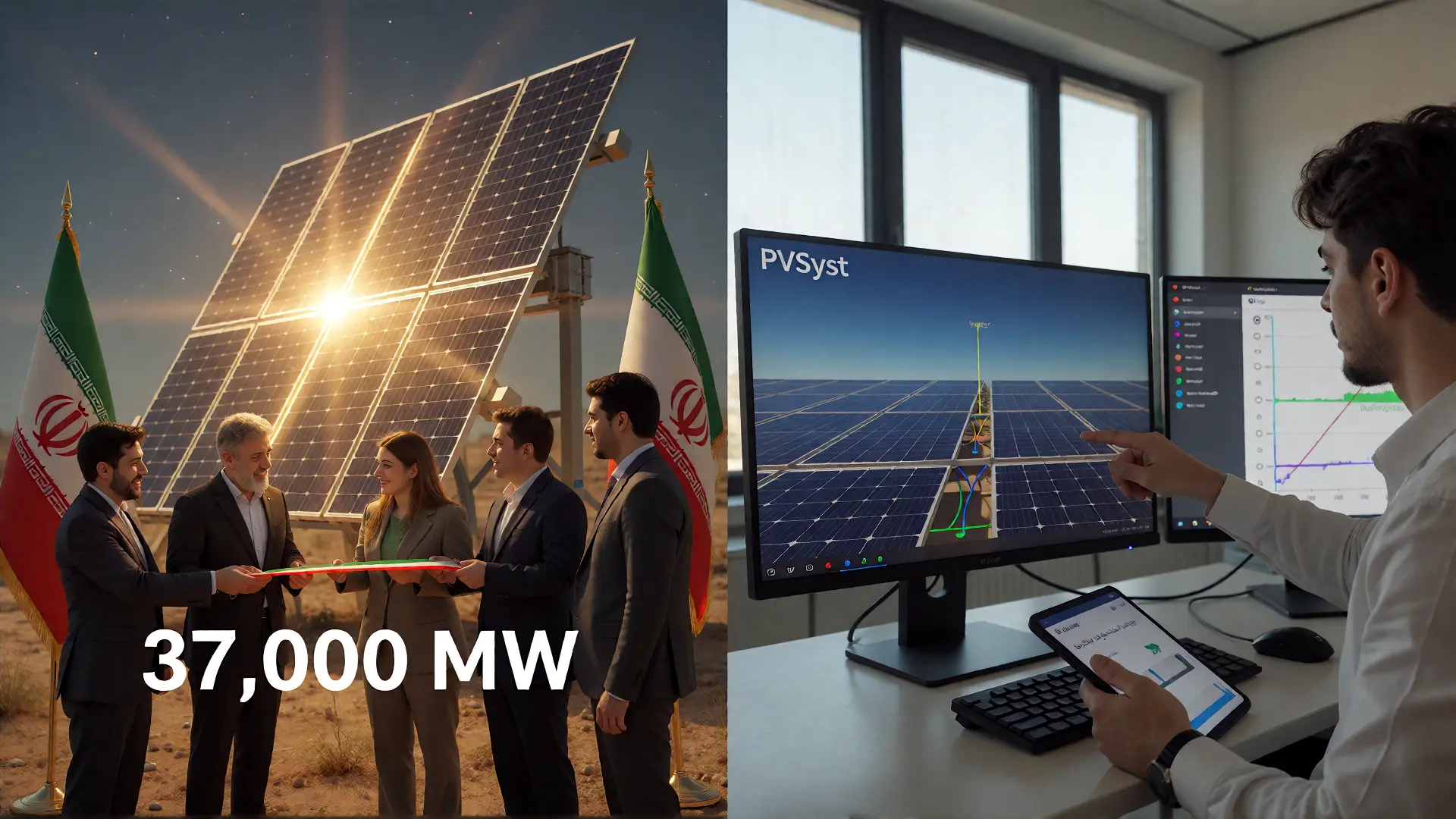
The solar energy industry in the final days of summer 1405 has faced a wave of hopeful and transformative news. From the allocation of land for the production of 37,000 megawatts of solar electricity in Iran to the inauguration of the largest solar power plant in North Khorasan Province, and from the unveiling of the first solar project fund on the Energy Exchange to the remarkable growth of global investment in this field. These events all indicate that solar energy is no longer an alternative option, but has become the main pillar of energy supply in Iran and the world, and a new era of rapid, intelligent, and sustainable development in this industry has begun.
Part One: Enough Land for a Solar Revolution in Iran
In news published by the head of the country’s Land Affairs Organization, it was announced that the necessary land for creating the capacity to produce more than 37,000 megawatts of electricity through solar energy has so far been provided to operators. Over the past two years, the Ministry of Agriculture-Jihad has allocated about 57,000 hectares of national and government lands for the implementation of projects related to solar energy, and with full utilization of this capacity, a significant portion of the country’s energy deficit can be supplied through solar energy. This action demonstrates the government’s serious determination to overcome energy imbalance and move toward utilizing clean and renewable resources.
Part Two: The Largest Solar Power Plant in the Northeast Was Connected to the Grid
Continuing this path, the 72-megawatt solar power plant in Esfarayen County, North Khorasan, as the largest solar power plant in this province, was connected to the national electricity grid in the presence of the Minister of Energy. This power plant, built on a land area of 121 hectares, will generate about 145,000 megawatt-hours of electricity annually, which will greatly help reduce dependence on fossil fuels. The annual operation of this power plant will result in saving 39 million cubic meters of natural gas and 32,000 cubic meters of water and will reduce greenhouse gas emissions by 101,000 tons per year, equivalent to the annual emissions of 41,000 cars. This project is part of the government’s extensive effort to compensate for the country’s electricity deficit, which reached 14,000 megawatts this summer, and with the inauguration of this power plant, the country’s clean energy capacity has surpassed 5,500 megawatts.
Part Three: Unveiling of a New Financial Instrument for Solar Development
In an important structural and financial development, the ceremony for the beginning of the subscription of investment units of the solar electricity project fund (Noor) was held at the Securities and Exchange Organization. This fund, which is considered the first instrument for direct financing of renewable energy projects through the capital market, provides a transparent and attractive platform for the participation of small and large investors in the construction of solar power plants. The spokesperson of the Parliament’s Energy Commission at this ceremony emphasized the necessity of accurate valuation of solar electricity on the exchange and creating price balance for producers and predicted that by the end of the year we would reach 12,000 megawatts and by the end of the fourteenth government, 30,000 megawatts of solar electricity. This action is considered an important step toward popularizing the financing of clean energy and attracting idle capital into the production sector.
Part Four: Fivefold Growth and Full Support for Domestic Manufacturers
Official statistics show that the country’s solar energy capacity has increased more than fivefold over the past two years, from about 1,250 megawatts to more than 5,800 megawatts. The Minister of Energy at the inauguration ceremony of two 95-megawatt solar power plants in Tehran Province emphasized the necessity of special attention to the development of renewable power plants on a household and small scale and appreciated SATBA’s efforts to collect small capital and direct it toward renewable projects. The President also at this ceremony announced that Iran will fully support investors and domestic manufacturers of solar panels and proposed suggestions such as cultivating medicinal plants around power plants and recycling panel washing water for greater productivity. The Central Bank’s support by allocating 17 billion dollars of financial resources to the development of solar energy and providing foreign currency and rials without restrictions for domestic manufacturers demonstrates the serious determination of the banking system in supporting this industry.
Part Five: Global Trends; Investment and Technological Competition
At the global level, capital attraction in the solar industry has faced astonishing growth. According to a report by Mercom Capital Group, corporate investment in the solar sector in the first quarter of 2026 reached 11.1 billion dollars with a 131 percent growth compared to the previous year. Investment through the stock market has seen a 5,400 percent growth, and financing through bonds has also increased by 154 percent. These figures show that global investors have complete confidence in the outlook of the solar industry.
In the field of technology as well, competition to achieve higher efficiencies continues. The Chinese company LONGi in July 2026 unveiled a new solar cell with an energy conversion efficiency of 35.5 percent, which has been confirmed by a European reference laboratory. Although mass commercialization of this technology remains the main challenge, this achievement indicates that the boundaries of solar technology are still expanding. The Korean company Hanwha Qcells, in collaboration with NASA, has also begun testing perovskite cells on the lunar surface for space applications.
Conclusion: A Bright Future on the Horizon
The collection of this news and developments paints a picture of an industry in the midst of a leap. In Iran, land allocation for 37,000 megawatts, the inauguration of large power plants, and the launch of new financial instruments all demonstrate a serious determination to solve energy imbalance through the sun. In the world, the growth of investment and technological competition outlines a clear path for the sun’s dominance over the energy market. For leading companies such as Energy Gostar Hooran Paya, this environment provides a unique opportunity to play a role in this great transformation and help realize national goals in the field of clean energy. The new era of solar energy has begun today, with these very news items.
