
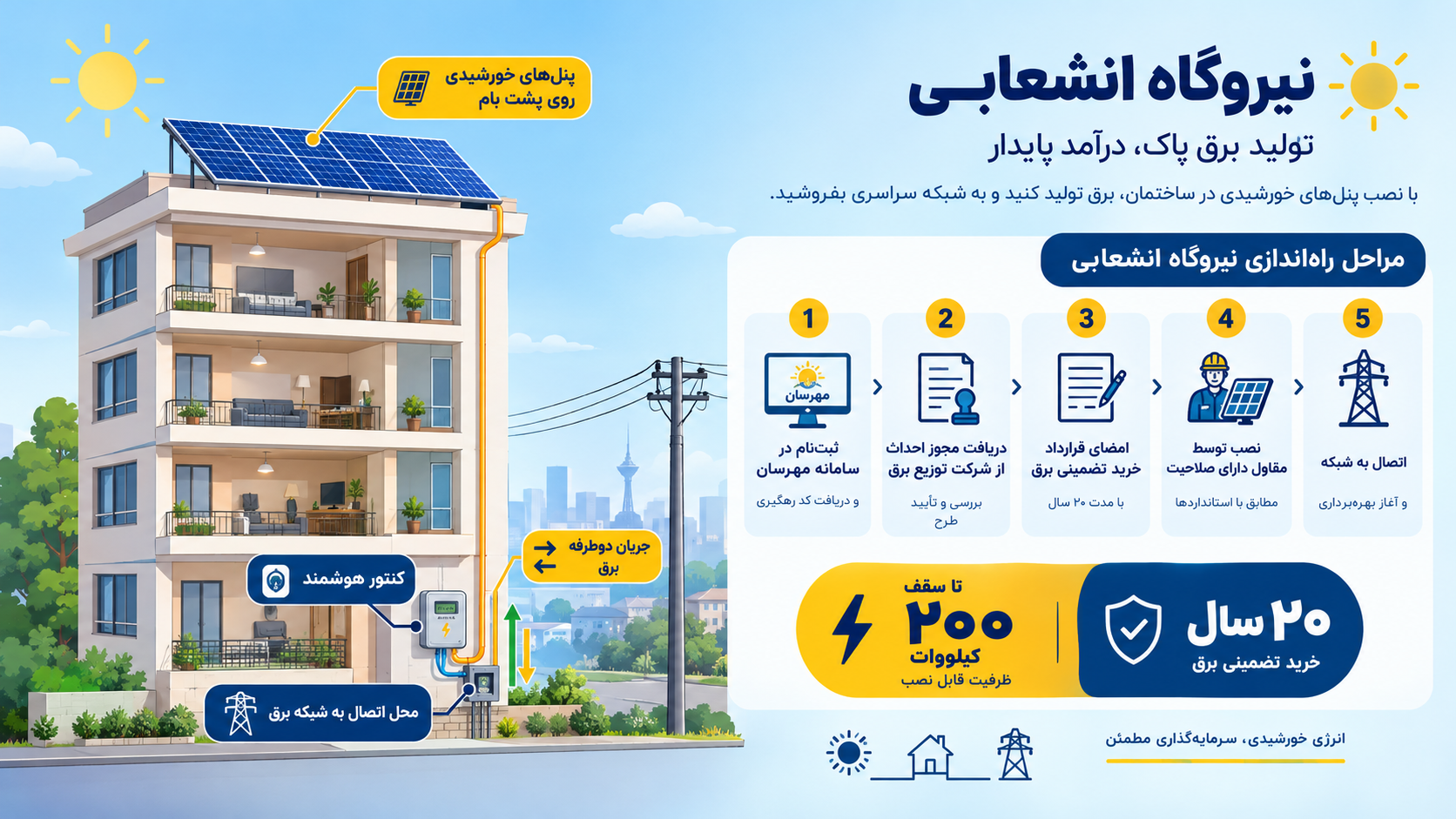
What is a distributed power plant and how does it differ from a centralized power plant?
A distributed solar power plant, also known as a “household power plant” or “capacity-limited distributed power plant,” is a system whose capacity is limited to the building’s electrical load and up to the approved limit. According to Satba’s guidelines, residential applicants can request the installation of a solar power plant up to twice the distributed capacity that the distribution company has assigned to them. For example, a building with a 25-ampere single-phase distribution capacity, equivalent to 5 kilowatts, can install a power plant up to 10 kilowatts in capacity.
In contrast, centralized or large-scale power plants are constructed on vast lands, with capacities ranging from hundreds of kilowatts to hundreds of megawatts. To obtain a permit for these power plants, applicants must refer to the National Licensing Portal (website: ir.mojavez), while permits for distributed power plants up to 200 kilowatts are issued by electricity distribution companies. This difference in the issuing authority significantly simplifies and accelerates the administrative process for distributed power plants.
Approved Capacity and Set Limits
According to issued guidelines, distributed power plants up to a capacity of 200 kilowatts receive permits from electricity distribution companies. However, there are differences in approved capacities. For ordinary subscribers, the capacity of the power plant is limited to twice the distributed capacity and a maximum of 100 kilowatts. However, in a new announcement, the Ministry of Energy has increased the authority of electricity distribution companies to enter into contracts with applicants from 200 kilowatts to 1 megawatt, and the acceptance of capacity up to 5 megawatts is currently being piloted in five distribution companies.
For commercial and residential buildings with four floors or more, or with a total floor area exceeding one thousand square meters that are subscribers to electricity, installing solar panels has become mandatory. The minimum nominal capacity of the system for these buildings is set at 5, 10, 15, and 20 kilowatts. This requirement is considered a significant step toward reducing pressure on the power grid during peak consumption hours.
Steps to Connect to the Power Grid: Step-by-Step
The process of establishing and connecting a distributed solar power plant to the power grid is a 21-step procedure that begins with registration in the Mehrsun System (mehrsun.satba.gov.ir). Applicants enter their details into this system and register their electricity bill number. After initial reviews, the administrative process continues.
The first practical step is obtaining a construction permit from the local electricity distribution company. Applicants must visit the distribution company’s website and select the option “Providing Services for Distributed Energy Generation” from the “Electronic Service Desk” menu. At this stage, the request for installing a solar generator is submitted. Next, applicants must visit the distribution company to obtain a Guaranteed Power Purchase Agreement. This agreement, valid for 20 years, fixes the purchase price of the generated electricity and includes annual adjustments based on inflation rates.
After signing the contract, applicants can select their preferred qualified contractor from among the approved contractors listed in the Mehrsun system, verified by Satba. The installation and commissioning are carried out by the contractor, and subsequently, a smart meter is installed by the distribution company. From this point, electricity generation and injection into the grid begin, and income generation for the power plant owner commences.
Key Documents and Requirements
To obtain a permit for a distributed power plant, applicants must have an electrical connection (meter). If the building lacks an electrical connection, applicants can use a virtual connection. A virtual connection is solely for electricity generation and does not allow electricity to be drawn from the grid; however, it can be transferred to any location where power lines exist.
Regarding documentation, applicants must provide their electricity bill number, identity documents, and information about the land or building where the installation will take place. For power plants with capacity exceeding 200 kilowatts that require the use of natural resource lands, an inquiry from natural resources and obtaining a land transfer approval is necessary. For privately owned agricultural lands, the issue of preserving or changing land use is reviewed by the Land Use Commission under Article 1, Paragraph 1.
Advantages and Incentives of Distributed Power Plants
Distributed power plants have several key advantages. First, rapid permit issuance: permits for power plants up to 200 kilowatts are issued within 24 working hours in some provinces. Second, exemption from land requirements: distributed power plants do not require large land areas and are installed on rooftops or building premises. Third, higher guaranteed purchase rates for smaller capacities: the purchase rate for power plants up to 200 kilowatts in 1405 was set at 5,854 tomans per kilowatt-hour, which is higher than the rate for larger capacities.
Fourth, access to bank financing. Satba, in cooperation with Bank Mellat, provides low-interest loans up to 4 billion rials (400 million tomans) for establishing distributed power plants up to 10 kilowatts. These loans, at an interest rate of 14%, are provided through Satba-approved financing platforms, and applicants can repay installments from their own power plant income.
Conclusion: A Practical Step Toward Clean Energy
The distributed solar power plant serves as a bridge between ordinary citizens and the clean energy industry. Unlike the common perception that electricity generation is solely the responsibility of the government or large corporations, a distributed power plant enables every building owner to become a power producer. With attractive guaranteed purchase rates, low-interest bank financing, and streamlined administrative processes, entry into this field has never been this easy. For those who have a sun-facing rooftop and an electrical connection, establishing a distributed power plant is not only a profitable investment with a 4-5 year payback period, but also a practical contribution to reducing the country’s electricity imbalance and moving toward a sustainable future. Leading companies such as Enegi Gostar Horan Paya also facilitate entry into this field by providing consultation, design, and installation services for distributed power plants.
