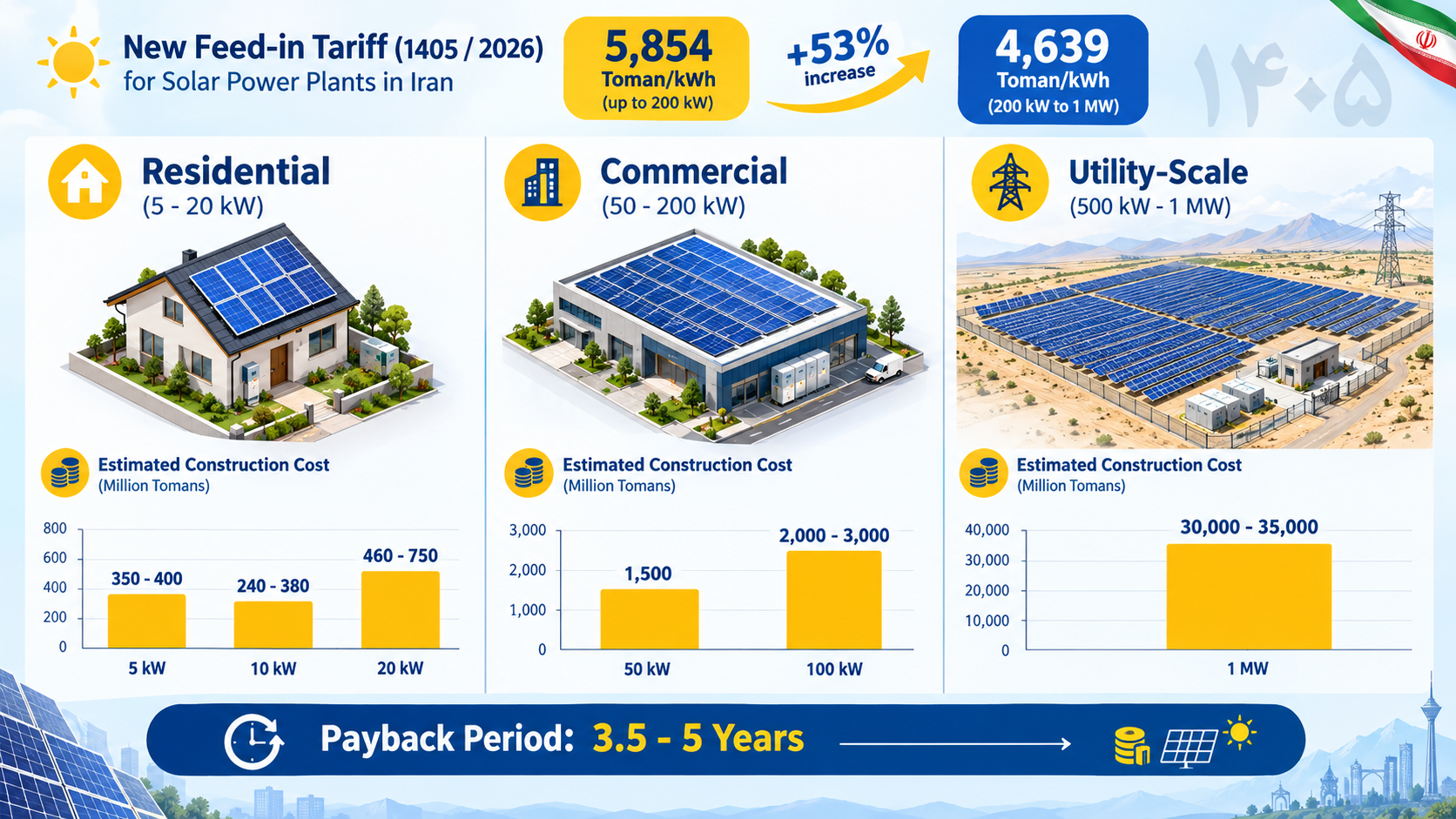
The year 1405 can be considered a turning point in Iran’s solar energy economy. The new directive issued by the Ministry of Energy in the month of Farvardin increased the guaranteed purchase price for solar electricity by more than 50 percent, fundamentally altering the return-on-investment calculations for investors. Given that construction costs have also risen by approximately 20 percent due to inflation and customs changes, the key question is: Is investment in solar power plants still economically viable in 1405? The answer is determined by a detailed analysis of costs, new purchase rates, and actual revenue for each capacity.
Small-scale power plants (5 to 20 kW); households entering with new rates
Power plants in the 5 to 20 kW range remain the most sought-after option for households. According to Zahra Olya, Director General of the Economic Review Office of SATEBA, the estimated cost of constructing a 5 kW power plant is currently between 350 to 400 million tomans. This amount includes panels, inverters, structures, cabling, and installation costs.
The key point of 1405 is the jump in the guaranteed purchase rate. The base rate for power plants up to 200 kW has increased to 58,540 rials (equivalent to 5,854 tomans) per kilowatt-hour, showing a 53 percent growth compared to the previous year. This increase raises the annual income of a 5 kW power plant to approximately 52 million tomans and reduces the payback period to 4 to 4.5 years.
For a 10 kW power plant, construction costs vary between 240 to 380 million tomans, and a 20 kW power plant costs between 460 to 750 million tomans. The estimated annual income for these two capacities is approximately 105 million and 210 million tomans, respectively.
Medium-scale power plants (50 to 200 kW); an option for businesses
Power plants in the 50 to 200 kW range are usually constructed by businesses and large landowners. The estimated construction cost for a 50 kW power plant is around 1.5 billion tomans, and for a 100 kW power plant, it is approximately 2 to 3 billion tomans.
The guaranteed purchase rate for these capacities varies depending on the type of contract. Power plants up to 200 kW that are contracted under Article 61 (20-year rial contract) benefit from a rate of 5,854 tomans. Power plants equipped with battery storage also receive a higher rate of 9,117 tomans, which is considered an incentive for developing hybrid systems.
The estimated annual income for a 100 kW power plant under the rial contract is around 585 million tomans, and for a 200 kW power plant, it is approximately 1.17 billion tomans. The payback period for these capacities is typically 3.5 to 5 years.
Large-scale power plants (500 kW to 1 MW)
Large-scale power plants are designed for professional investors and are usually constructed on large plots of land. The estimated construction cost for a 500 kW power plant is around 210,000 dollars, and for a 1 MW power plant, it ranges between 3 to 3.5 billion tomans. The land required for a 1 MW power plant is approximately 1.5 hectares.
The guaranteed purchase rate for power plants between 200 kW and 1 MW in 1405 is set at 46,386 rials (approximately 4,639 tomans), representing a 47 percent increase compared to the previous year. This rate applies to 20-year rial contracts.
The estimated annual income for a 1 MW power plant under the rial contract is around 7 billion tomans. The payback period for these capacities is typically 4 to 6 years. For larger power plants, the option to enter into foreign currency contracts (Article 12) is also available, which provides dollar income and greater protection against domestic inflation.
Factors affecting cost and key points of 1405
Several key factors influence the final construction cost in 1405. Customs changes on solar panels along with the new year’s inflation have increased construction costs by approximately 20 percent. Exchange rate is the most critical variable; most solar power plant equipment is imported, and currency fluctuations directly affect prices. Equipment quality also makes a significant difference; higher-efficiency panels and reputable inverters have higher upfront costs but provide greater energy output and longer durability over time.
Another important point is the difference in purchase rates across different capacities. The purchase rate for power plants up to 200 kW (5,854 tomans) is higher than for those between 200 kW and 1 MW (4,639 tomans), indicating greater government support for small and household investments.
Conclusion; choosing capacity according to objective
Choosing the capacity of a solar power plant in 1405 requires balancing available capital, available space, and investment objectives. For households, a 5 to 10 kW power plant with a cost of 350 to 400 million tomans and a payback period of 4 to 4.5 years is considered a secure and low-risk option. For businesses, a 100 kW power plant with an annual income of approximately 585 million tomans and a payback period of 3.5 to 4 years offers high economic attractiveness. And for professional investors, power plants of 500 kW and above, with foreign currency income and export potential, represent a strategic option.
Given the unprecedented jump in guaranteed purchase rates in 1405, timing is crucial for entering this market. The 50 percent increase in purchase rates has opened a window of opportunity that may be adjusted in future years.