
Choosing the type of solar panel is one of the first and most important decisions that every investor in the solar energy field faces. This choice not only affects the initial cost of the project but also shapes the production efficiency, lifespan, and final economic return. In the Iranian market, two main options are available to applicants: monocrystalline and polycrystalline panels. While in global markets, polycrystalline technology is heading toward obsolescence, it is still used in some domestic projects due to its lower price. But is this economic choice also reasonable under Iran’s climatic conditions? Answering this question requires a careful examination of technical differences, performance at high temperatures, and the behavior of the two technologies in real conditions.
Fundamental Differences in Structure and Efficiency
Both monocrystalline and polycrystalline technologies are made from silicon, but their production process and crystalline structure differ. Monocrystalline panels are made from a single silicon crystal that has a uniform structure without grain boundaries. This orderly structure allows electrons to move more freely and brings higher efficiency. In contrast, polycrystalline panels are composed of multiple small crystals whose boundaries create an obstacle to the flow of electrons and consequently reduce efficiency.
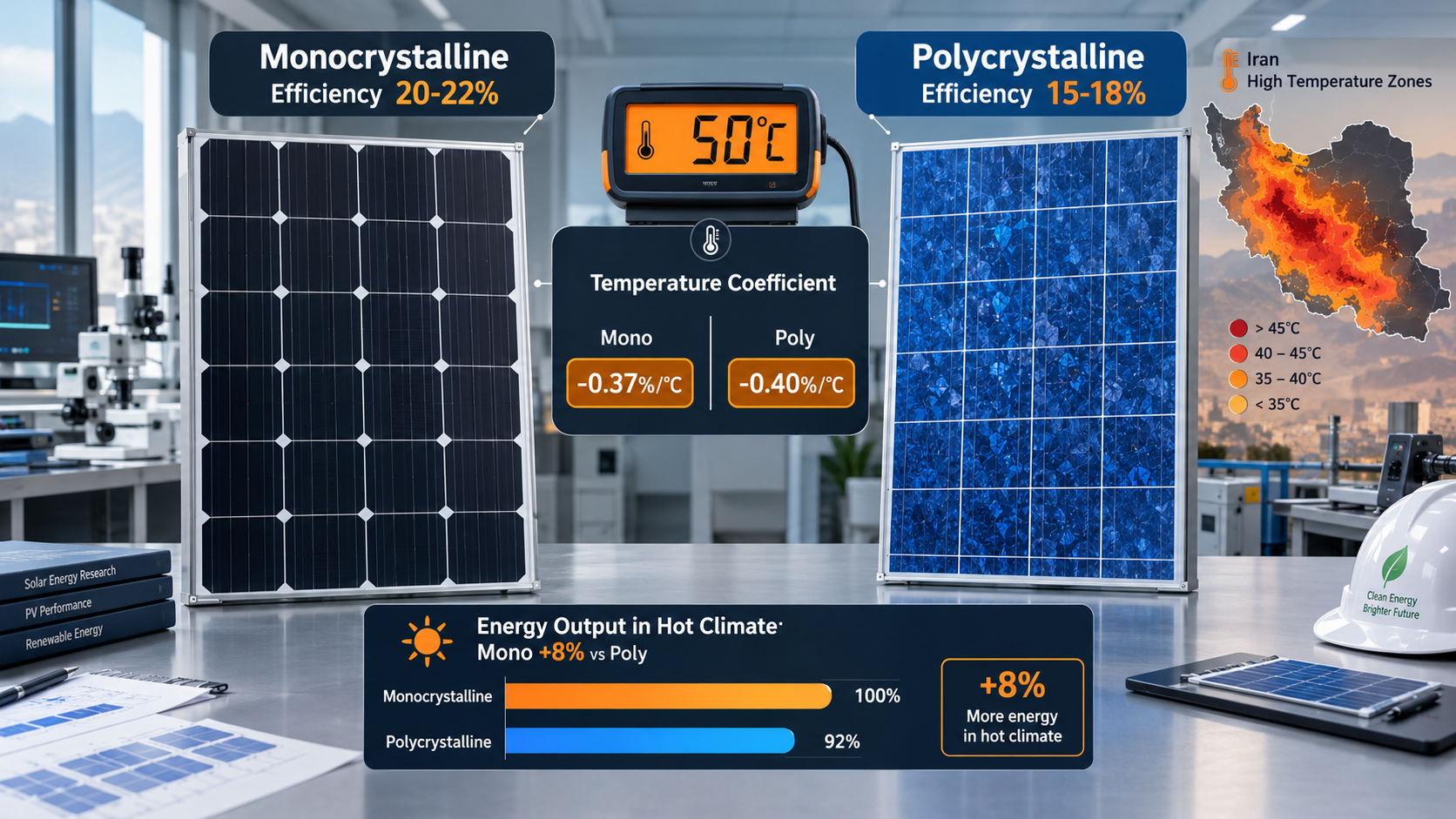
Numerically, the efficiency of monocrystalline panels is usually between 20 and 22 percent for PERC technology and up to 24 percent for more advanced technologies such as TOPCon. In contrast, the efficiency of polycrystalline panels is between 15 and 18 percent. This difference of a few percent may seem negligible at first glance, but in a 5-kilowatt project, it means needing more space to install polycrystalline panels or producing less energy in the same space.
Performance at High Temperatures; The Hidden Weakness of Polycrystalline
One of the key factors that must be considered when choosing a panel for Iran’s climate is the panel’s behavior at high temperatures. The temperature coefficient of a panel indicates the rate of efficiency reduction per degree of temperature increase beyond 25 degrees Celsius. Monocrystalline panels usually have a better temperature coefficient; for example, the temperature coefficient of PERC technology is about -0.37 percent per degree and TOPCon technology is about -0.30 percent per degree. In contrast, polycrystalline panels have a weaker temperature coefficient, which is about -0.40 percent per degree or more.
This difference becomes doubly important in Iran’s hot climate. In regions such as Yazd, Kerman, and Sistan and Baluchestan, where panel temperatures during peak radiation hours can exceed 50 degrees Celsius, the better temperature coefficient of monocrystalline means more energy production during peak consumption hours. In other words, even if both panels have similar efficiency under standard laboratory conditions, under real and hot conditions in Iran, the monocrystalline panel will show better performance.
Behavior Under Shading Conditions and Hotspot Risk
Another issue that must be considered when choosing a panel for Iran is the panel’s behavior under shading conditions. Partial shading can lead to the formation of hot spots, which not only reduces efficiency but can also lead to panel destruction and even fire risk.
Experimental studies show that polycrystalline panels are more vulnerable to shading. In a comparative test, a polycrystalline panel reached a maximum temperature of 92.3 degrees Celsius when only 40 percent of the surface of one of its cells was shaded. In contrast, a monocrystalline panel under 60 percent shading reached a maximum temperature of 90.1 degrees Celsius, and this temperature decreased to 60 degrees as shading increased to 100 percent. This finding shows that polycrystalline reaches a dangerous temperature earlier and with less shading, while monocrystalline has more stable behavior.
Economic Analysis and Iranian Market Conditions
Despite the technical superiority of monocrystalline, one of the reasons polycrystalline is still used in some Iranian projects is its lower price. But this economic calculation may be misleading at first glance. Although the price per watt of polycrystalline is lower, achieving the same capacity requires more space. In projects where rooftop or land space is limited, this space limitation can impose additional costs such as more structures, longer cabling, and more labor.
Another important point is that in the global market, the share of polycrystalline is rapidly declining. Reports show that polycrystalline technology is becoming “obsolete,” and major manufacturers have moved toward more advanced monocrystalline technologies such as TOPCon and HJT. This trend means a gradual reduction in access to quality polycrystalline panels and an increased risk of supplying spare parts in the future.
Final Recommendation for Iranian Projects
Given Iran’s climatic conditions, which are characterized by high radiation and hot temperatures, monocrystalline panels, especially TOPCon technology, are a more logical choice for solar projects in Iran. Higher efficiency, better temperature coefficient, and more stable behavior under shading conditions are all factors that in the long term lead to more energy production and higher economic return. Although the initial price is higher, in the final calculation, considering the lower required space, greater durability, and more energy production over the 25-year life of the project, this price difference is compensated.
For projects with abundant space and limited budget that are constructed in cooler regions of Iran, polycrystalline may still be an option worth considering, but given the global trend and the gradual decline of this technology, long-term investment in it is associated with risk. Leading companies such as Energy Gostar Hooran Paya, which seek to provide sustainable and optimal solutions to their customers, usually recommend high-quality monocrystalline panels for Iranian projects.
