
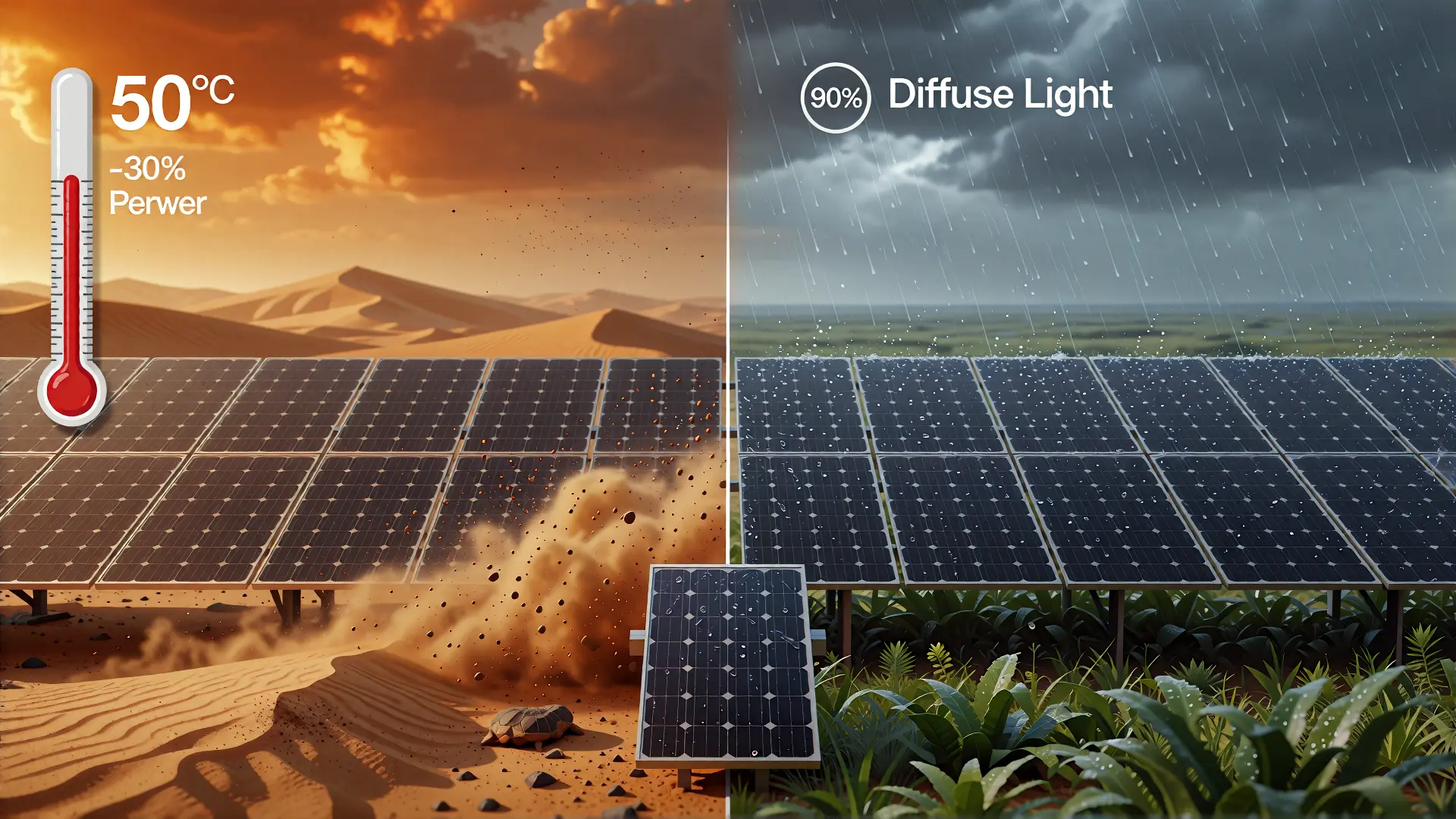
Constructing a solar power plant anywhere in the world is, before being a technical decision, a direct encounter with nature. Iran, with its stunning climatic diversity, from the central deserts to the rainy northern coasts, provides a vast field for solar energy development. But each of these regions presents unique challenges to engineers and investors. In the desert, the sun shines generously, but dust and scorching heat weaken the performance of panels. In rainy regions, clouds cover the sky and humidity threatens equipment. Accurate understanding of these challenges and the solutions to counter them is the main condition for success in any solar project.
Desert Challenges; When the Sun Also Causes Trouble
Iran’s desert regions, especially in the provinces of Yazd, Kerman, and Sistan and Baluchestan, enjoy the highest levels of solar radiation in the world. But this very generous nature also places serious obstacles in the way of power plant construction. Dust and sand are the number one enemy of solar panels in these regions. Sand and dust particles, which typically range in size between 10 and 100 micrometers, accumulate on the surface of panels and block light. Statistics show that dust accumulation can lead to a reduction of more than 30 percent in electricity generation. Abrasion of the glass surface of panels by sand particles can also reduce the lifespan of the protective coating by more than 32 percent and gradually lower system efficiency.
Extreme heat is another challenge. The operating temperature of panels in the desert can exceed 50 degrees Celsius, and this temperature increase reduces generation efficiency by up to 18 percent compared to standard conditions. Studies show that operation and maintenance costs at solar power plants located in deserts can be up to 50 percent higher than power plants in temperate regions. Construction in these regions also comes with its own specific challenges. Traditional methods of land leveling and vegetation clearing greatly increase wind erosion. Research in the Mojave Desert has shown that at sites prepared with conventional methods, the flux of suspended sediments in the air is twice as large as in undisturbed areas.
Challenges of Rainy Regions; When Clouds Cover the Sun
On the opposite side, Iran’s rainy and humid regions, such as Gilan and Mazandaran provinces, face different limitations. The first and most obvious challenge is the reduction of solar radiation intensity due to continuous cloud cover. But the main problem is not merely the lack of light, but the different quality of light in these conditions. In cloudy climates, the share of diffuse light becomes much greater than direct light, and this spectral change affects the performance of solar panels. Studies show that in areas with a high number of cloudy days, new-generation panels with TOPCon technology can have 4 to 7 percent higher generation than older panels, because they respond better to diffuse and blue light.
High humidity is also a serious challenge for equipment. According to statistics, more than 40 percent of the world’s regions are located in hot and humid climates, and in China, 84 percent of industrial companies are located in humid coastal areas where humidity can reach up to 90 percent. Humid air forms a continuous layer of water on the surface of panels, which not only reduces light transmission but also accelerates aging and cracking of the module by penetrating moisture. Corrosion of metals in humid environments is particularly prominent and can lead to poor contact, abnormal increase in resistance, and other system errors. From a safety perspective, high humidity conditions significantly increase the risk of electrical fire and electric shock.
Solutions; From Anti-Dust Panels to Low-Impact Construction
Fortunately, the global solar industry has developed effective solutions to counter these challenges. For desert regions, leading manufacturers have designed panels specifically built for harsh desert conditions. For example, DesertBlue modules from JA Solar, which are designed with anti-dust nanoscale coating and reinforced steel frames, can reduce the reduction in light transmission caused by dust by more than 32 percent and increase the useful life of the panel by three to five years. These panels have recorded up to 7 percent more energy generation than ordinary panels in real desert conditions.
On the side of rainy regions, solutions focus on waterproof structures and corrosion-resistant materials. The use of barrier materials with high transparency and waterproof properties, multilayer design for sealing, and improvement of structural drainage systems are among these solutions. For electrical equipment, the use of moisture-resistant components with high insulation and the application of anti-rust coatings on metals is essential. Also, real-time monitoring systems and periodic inspections for rapid identification of corrosion and moisture damage are of great importance.
In the field of construction as well, new approaches are being formed. Low-impact construction methods that leave vegetation and soil structure undisturbed can significantly reduce wind erosion. Research in the Mojave Desert has shown that sites built with the “overland travel” method produce only 5 to 10 times the sediment of undisturbed areas, while leveled sites release 100 times more sediment. Also, the use of solar trackers with the ability to adapt to the natural slope of the land minimizes the need for extensive leveling and heavy earthworks and reduces construction costs.
Conclusion; Climate-Appropriate Design, the Key to Success
Global and domestic experience shows that there is no single solution for all climates. A successful solar power plant in the Yazd desert requires completely different design, equipment, and maintenance approaches from a power plant constructed in the rainy plains of Gilan. For companies such as Energy Gostar Hooran Paya that intend to implement projects throughout Iran, this means the necessity of “climate-appropriate” design for each project. Selecting panels suitable for environmental conditions, designing a special cleaning and maintenance system, and adopting low-impact construction methods are all factors that determine whether a solar power plant will be a profitable investment or a costly experience after 25 years. Iran, enjoying both types of climate, has a unique opportunity to develop indigenous technical knowledge in this field, and this knowledge can become an export advantage for the country.
