
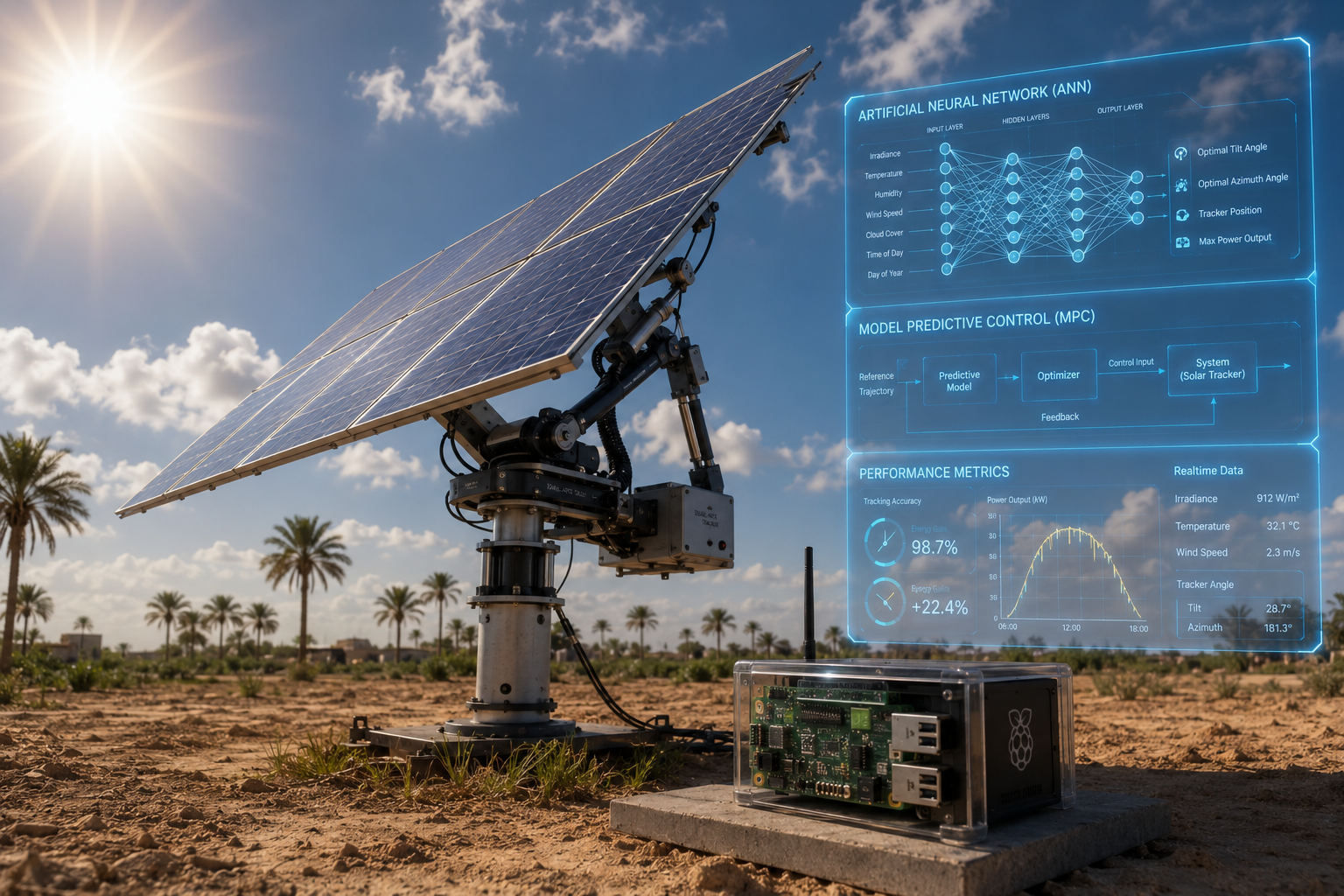
Researchers at Aswan University in Egypt unveiled an advanced two-axis solar tracker system at the International Solar Energy Conference in January 2026, which employs four different control strategies. This system, the results of which have also been published on the IEEE Xplore platform, is capable of keeping solar panels perpendicular to the sun’s rays with an accuracy of better than one degree, thereby increasing energy capture by up to 45% compared to a fixed system.
The four control strategies employed are: an optical tracker based on LDR sensors, a GPS-based tracker that calculates the sun’s position from geographical coordinates and time, Model Predictive Control (MPC), and Artificial Neural Networks (ANN). Experimental tests under various weather conditions in Egypt showed that ANN- and MPC-based methods had the best performance in accurately tracking the sun’s path throughout the day. Artificial neural networks were able to reduce tracking error to less than 0.5 degrees by learning the sun’s movement patterns and adapting to dynamic environmental conditions such as passing clouds.
One of the innovations of this project is the use of a low-power Raspberry Pi microprocessor to run the algorithms, which keeps the system’s hardware cost very low. According to the research team lead, this system is cost-effective for medium-sized solar plants and even residential arrays, with a payback period of less than two years.
In May 2025, Big Sun Energy company unveiled its commercial two-axis tracker named “SunTracker-AI” at the Las Vegas Solar Expo. This product, developed in collaboration with Aswan University, when combined with bifacial modules, can increase annual production by 45% to 100% compared to fixed systems. The tracker is also equipped with a strong-wind protection algorithm; if wind speed exceeds a threshold, the panels return to a horizontal position to avoid damage.
These achievements demonstrate that integrating low-cost hardware with intelligent algorithms is a practical way to increase solar energy efficiency without significantly increasing costs. Imagine each solar panel behaving like an intelligent sunflower—not only with mechanical rotation but also by predicting cloudy skies and calculating the optimal angle through artificial intelligence.
