
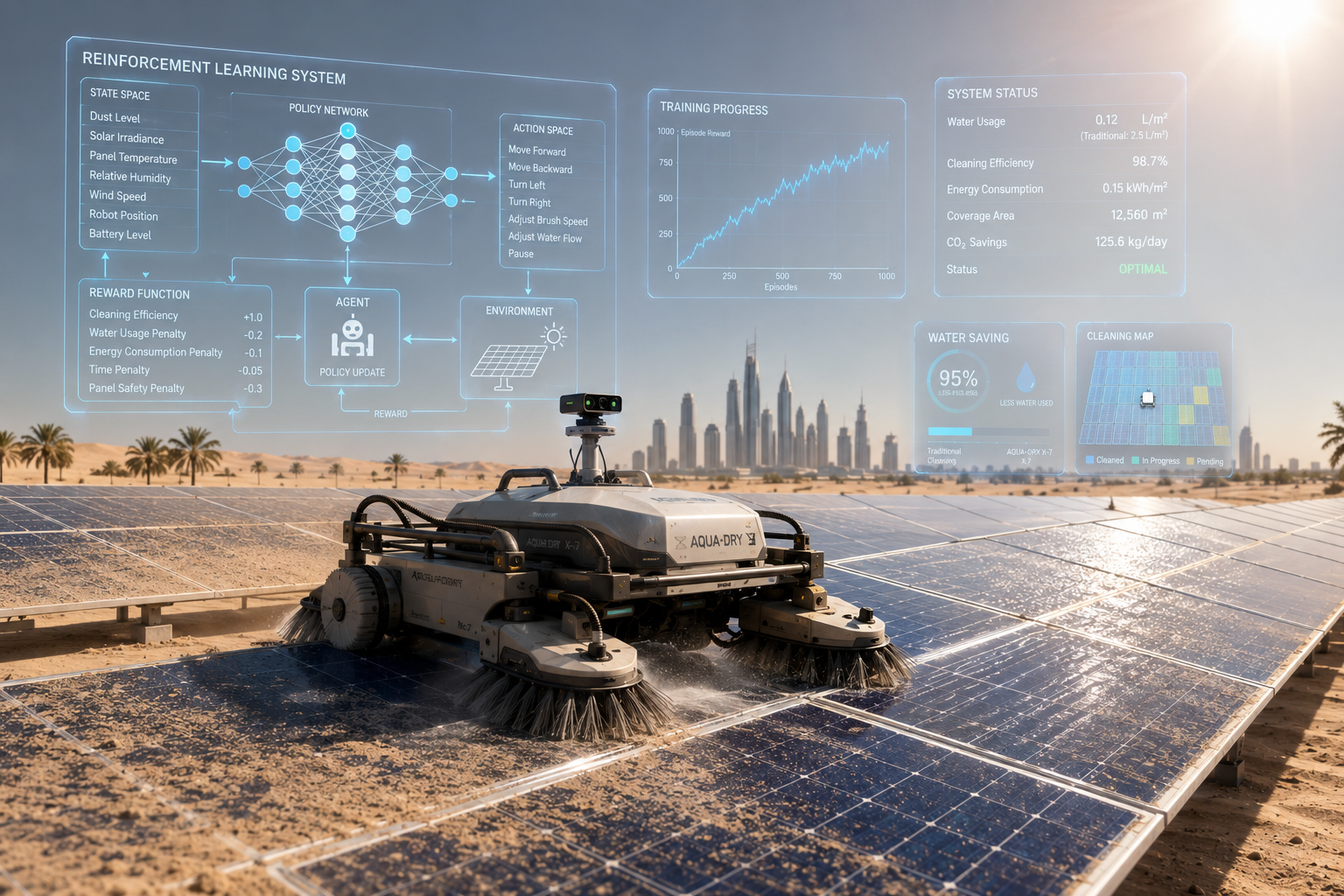
Researchers at Khalifa University in Abu Dhabi, in late April 2025, presented a new framework based on reinforcement learning that automatically optimizes the timing of solar panel cleaning in dry, dusty regions. Dust accumulation can reduce solar energy production by up to 40%, but traditional cleaning methods are either fixed schedules (e.g., weekly), which waste water and money, or based on human judgment, which is often suboptimal.
The proposed algorithm uses two advanced reinforcement learning techniques called PPO and SAC. These algorithms, by receiving real-time data on irradiance, humidity, wind speed, and the amount of dust settled on the panels, decide whether to perform cleaning at that moment or not. The main objective is to maximize net energy production in the long term while considering cleaning costs (including water consumption, robot electricity, and wear and tear).
This method was tested live for three months at a 10 MW solar plant on the outskirts of Abu Dhabi. Results showed that the PPO technique saved up to 13% in operational costs compared to traditional simulation-based optimization methods, while simultaneously increasing energy production by 7%. The algorithm learned to perform immediate cleaning after a sandstorm, but if the dust was light, it would wait for natural wind to remove part of it.
In a related development, the Israeli company BladeRanger, in collaboration with Bahrain’s Alpha Solar, signed an agreement to provide advanced cleaning technology using AI-equipped drones. These flying robots, using digital twins and reinforcement learning-based training, are capable of maneuvering in difficult angles and between panel rows.
The importance of this achievement is significant for countries in the Middle East, North Africa, and India that face dust phenomena. Instead of heavy investment in expensive self-cleaning panels, higher efficiency can be achieved from conventional cleaning systems through intelligent algorithms. This research showed that artificial intelligence creates value not only in the design phase but also in daily operations.
