
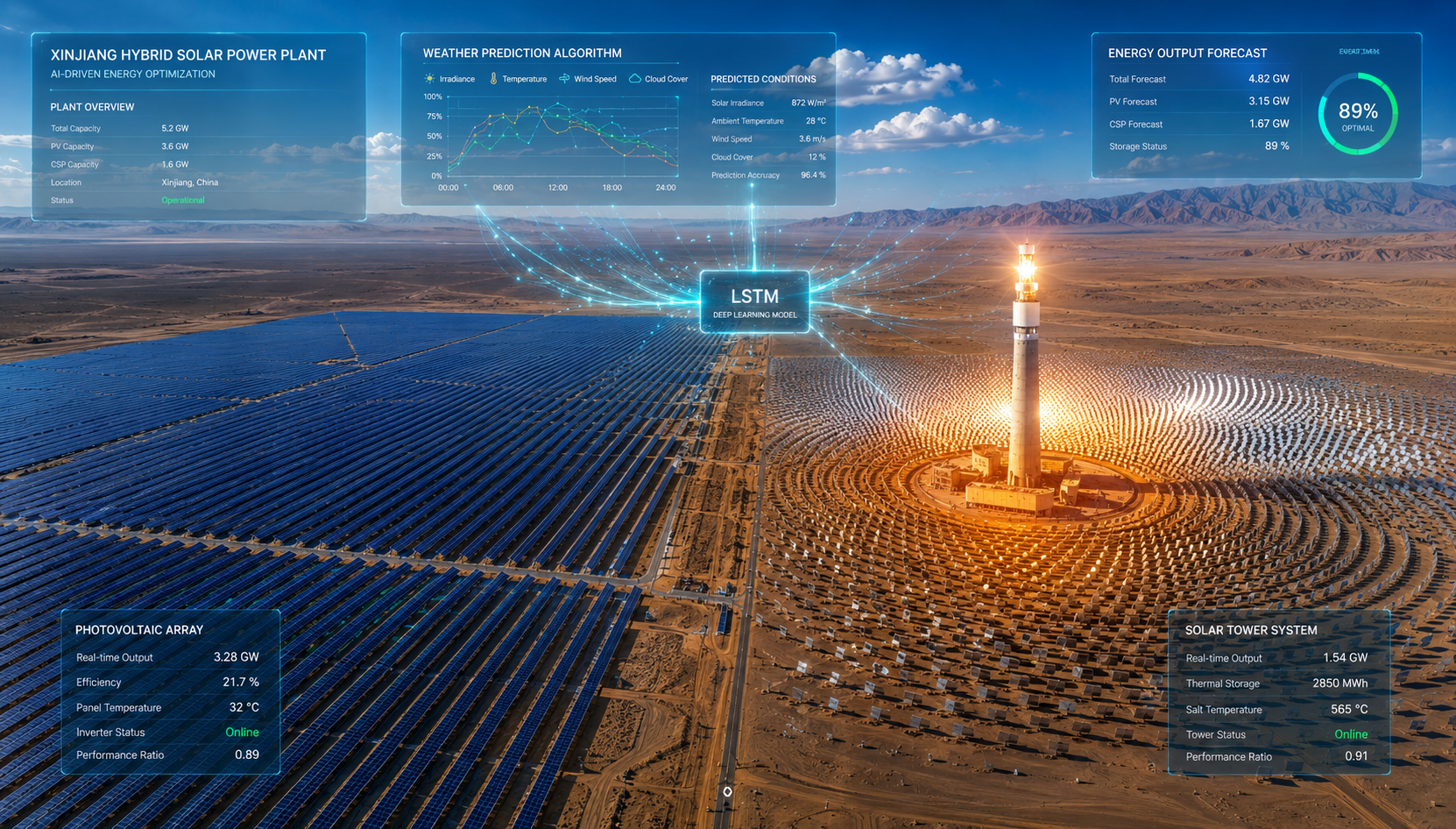
In late April 2025, China Energy Engineering Corporation officially began construction of the world’s largest hybrid photovoltaic and solar thermal power plant in the Xinjiang Autonomous Region. This massive project, with an investment of $950 million, includes 1.35 GW of photovoltaic solar capacity and 150 MW of molten salt tower capacity. The hybrid design of the plant is such that the photovoltaic panels supply daytime energy, while the thermal section, with molten salt storage, provides stable power at night.
The strength of this plant lies in its extensive use of artificial intelligence to coordinate the two sections. A central system based on deep neural networks and LSTM models analyzes real-time meteorological data, cloud cover forecasts, and grid consumption patterns, adjusting each section’s contribution to power supply accordingly. For example, if the algorithm detects that a thick cloud mass will enter the region within two hours, it commands the molten salt section to store extra heat several hours in advance, so that when photovoltaic output drops, it can immediately substitute.
This system also handles critical tasks such as primary frequency regulation and reactive power support. According to the manufacturer’s report, the use of predictive algorithms has reduced the plant’s output fluctuations by 75% compared to a purely photovoltaic plant. In other words, this plant behaves like a stable gas-fired plant, but without any carbon emissions.
The panels used in this project are N-type, which have high resistance to ultraviolet radiation and sandstorms. The selection of these panels was also carried out by environmental optimization algorithms that simulated the harsh desert conditions of Xinjiang. The plant is expected to reach full operation by the end of 2027, supplying stable 24-hour electricity to about 1.5 million households. This project demonstrates how artificial intelligence solves the biggest challenge of solar energy—namely, the intermittency of generation.
