
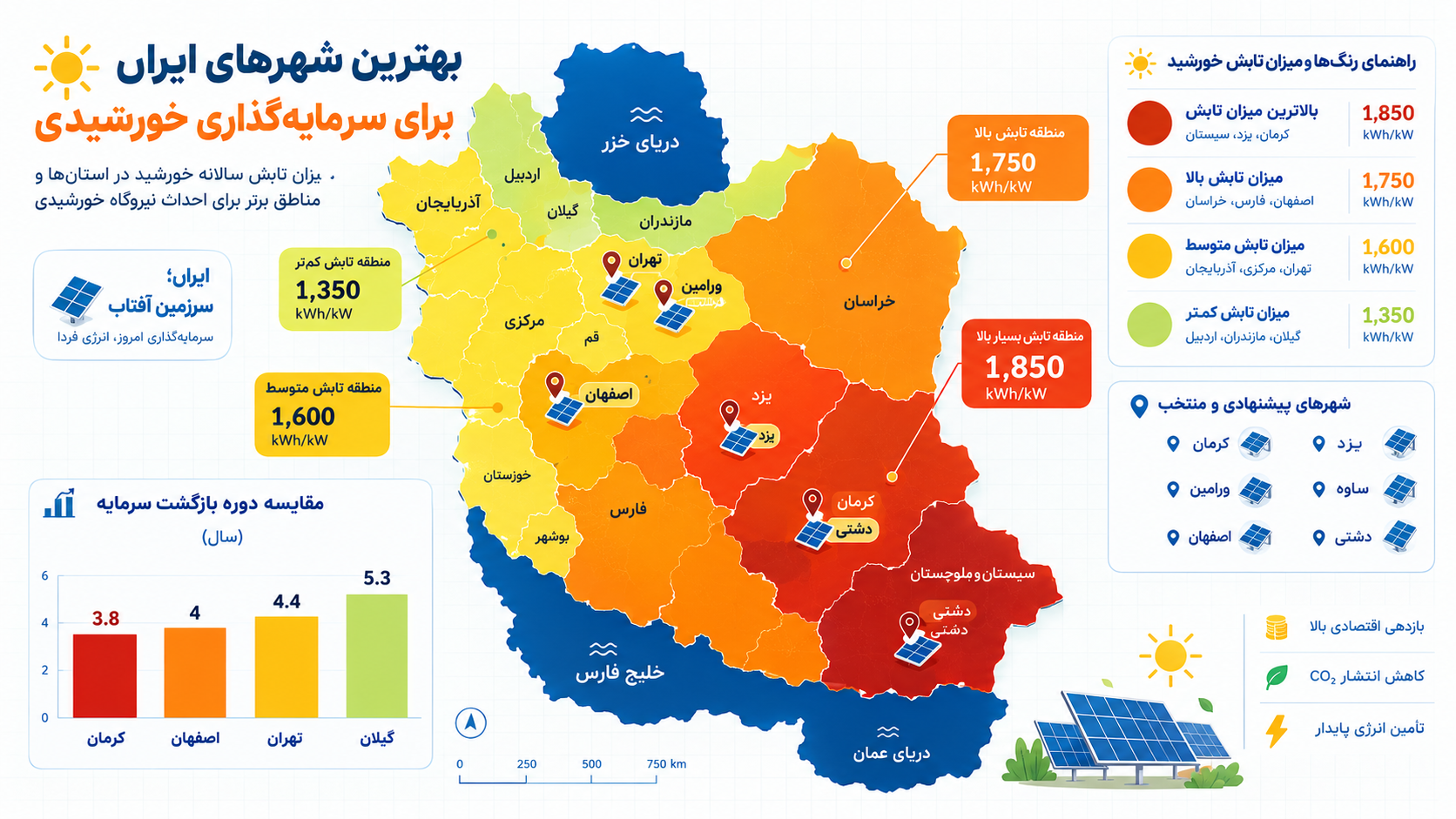
The choice of location is the most critical variable determining the economic return of a solar power plant. Iran, situated within the 25 to 40-degree north latitude solar belt, is among the few countries with an estimated annual average solar irradiance ranging between 1800 and 2200 kilowatt-hours per square meter—higher than the global average. However, this national potential is highly unevenly distributed at the provincial level. A solar plant with identical equipment produces approximately 1850 kilowatt-hours per kilowatt of capacity annually in Kerman province, whereas the same plant in Gilan yields only 1350 kilowatt-hours—a 37% difference that directly translates into income and return on investment. In this report, we examine the best cities and provinces in Iran for solar investment in 2025, based on irradiance data, grid infrastructure, and investment trends.
Kerman: Leading in Production Efficiency in the Country
Kerman province, with an annual production of 1850 kilowatt-hours per kilowatt of capacity, has secured the highest ranking for solar energy production in Iran. Cities such as Kerman, Sirjan, Rafsanjan, and Bardaskan are among the areas identified in initial studies for photovoltaic projects. Kerman’s advantage extends beyond irradiance; its vast size, presence of large low-yield lands, and significant industrial capacity (mining and mining industries) create a pathway for self-consumption of electricity for industrial units.
Economically, a 100-kilowatt rooftop solar plant in Kerman, requiring an investment of approximately 3.8 billion tomans, generates an annual income of 1.075 million tomans in the first year and achieves a 3.8-year payback period. In contrast, the same project in Gilan would have a payback period exceeding 5 years. Kerman’s primary challenge lies in dust and high summer temperatures, necessitating more frequent cleaning and selection of panels with appropriate temperature coefficients.
Yazd: Iran’s Most Recognized Solar Hub
Yazd is typically the first name that comes to mind when discussing solar energy in Iran. Its dry climate, clear skies for most of the year, and vast, relatively flat lands have made this province a classic choice for solar power plants. Flat lands reduce site preparation and installation costs, yet high summer temperatures and dust must be considered in design and operational cost estimates. Yazd, alongside Kerman and Sistan, ranks in the highest annual production category (1850 kilowatt-hours).
Varamin: Emerging Strategic Hub of Tehran Province with 2797 MW Capacity
Varamin, located in southeastern Tehran province, has become one of Iran’s strategic solar energy hubs in 2025. Currently, over 383 megawatts of solar power plants are under construction in this county, with an additional 2797 megawatts of capacity under review. The regional electricity authority of Varamin considers achieving these figures as transforming Varamin into one of the country’s primary clean energy production centers.
Grid infrastructure is also expanding in tandem: Tehran Regional Power Company is constructing 400-kilovolt substations in the Neshat area and surrounding regions of the 350-megawatt power plant to enable connection of this massive capacity to the national grid. Due to its proximity to Tehran and the extensive power grid, Varamin is considered a unique option for investors seeking large-scale projects with easy access to end consumers.
Savojbolagh: Industrial Capital Transitioning into a Solar Hub
Savojbolagh in Central Province, due to its suitable irradiance potential, geographic location, and proximity to major power substations, has become one of Iran’s key solar energy hubs. The identified capacity for solar power plant development in this county has reached approximately 2650 megawatts. By the end of August 2024, 216 megawatts of capacity had been realized through 45 projects in Savojbolagh, and larger projects such as the 550-megawatt PetroPars power plant have entered implementation phase. Savojbolagh’s advantage lies in the combination of suitable irradiance and presence of energy-intensive industries, enabling direct electricity sales or self-consumption.
Isfahan: Suitable Irradiance and Extensive Industrial Infrastructure
Despite its large industries, high electricity consumption, and more extensive grid, Isfahan province remains a suitable option for solar investment. Eastern regions and parts of the north of the province offer favorable climatic conditions. Isfahan, with an annual production of approximately 1750 kilowatt-hours per kilowatt, ranks second after Kerman and Yazd. The estimated payback period for a 100-kilowatt solar plant in Isfahan is around 4 years, which remains economically viable.
Dastjerd (Bushehr): The Future Solar Hub of Southern Iran
Dastjerd county in Bushehr province increased its defined solar power plant capacity to 500 megawatts in the past year. Due to its geographic location, high number of sunny days, and vast areas of suitable land, Bushehr is considered one of Iran’s best regions for solar development, and Dastjerd is now emerging as one of the future solar power production centers in southern Iran. This region is an attractive option for investors seeking large-scale land-based projects with high irradiance.
Summary: Solar Investment Roadmap for 2025
An overview of solar investment in Iran indicates that Kerman, Yazd, and Sistan offer the highest production efficiency and are most suitable for maximizing profit projects. Varamin and Savojbolagh, due to their proximity to the grid and industrial infrastructure, are ideal for large-scale and industrial self-consumption projects. Isfahan offers a balanced combination of irradiance and infrastructure, while Dastjerd presents an emerging hub with 500 megawatts capacity, offering early market entry opportunities in southern Iran. For individual investors and small businesses, central and southern provinces with irradiance exceeding 1750 kilowatt-hours per square meter can achieve payback periods of 3.5 to 4.5 years, whereas northern provinces with lower irradiance offer lower economic returns. The final decision should balance irradiance, grid access, land cost, and investment objectives.
