
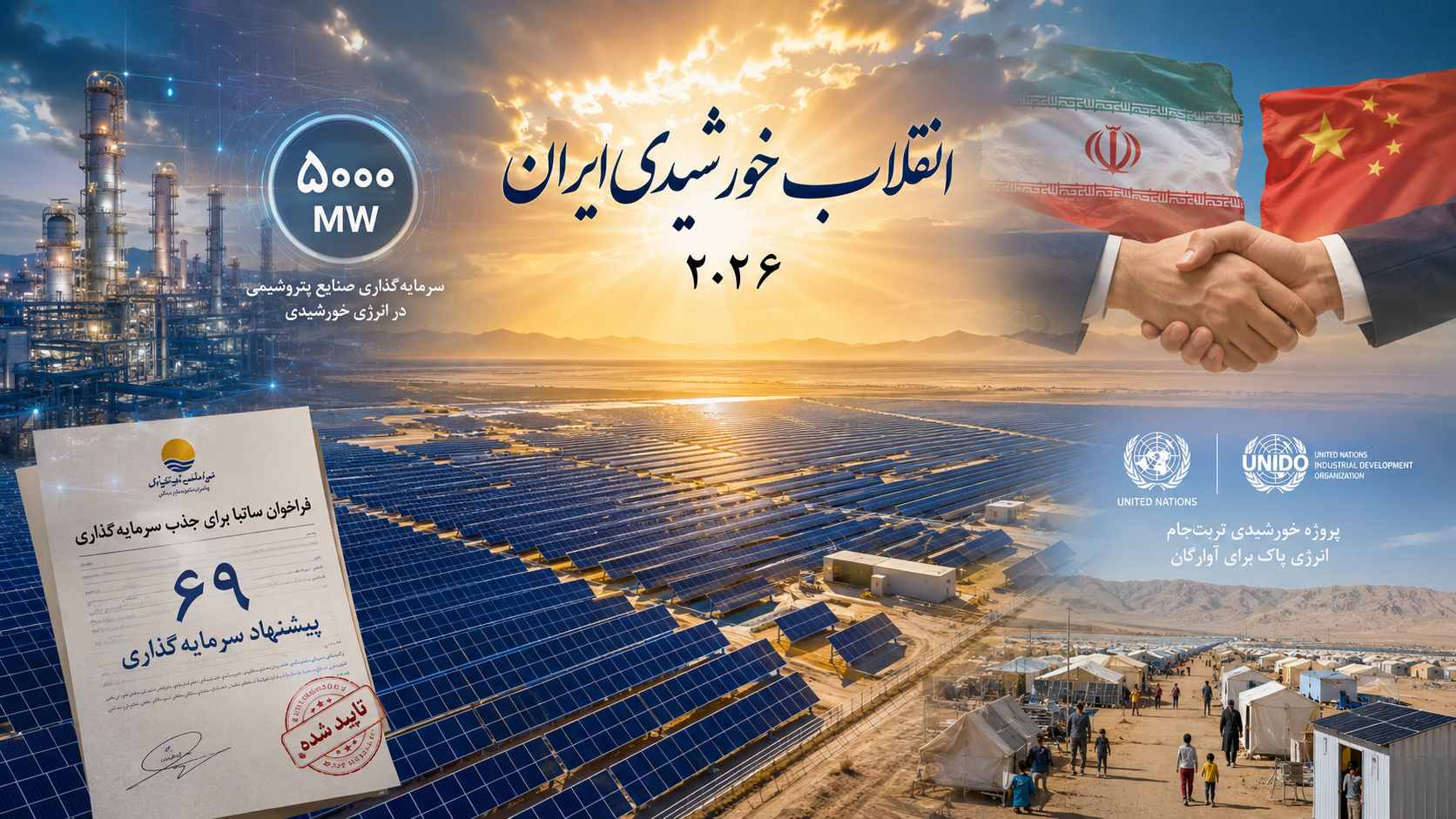
Iran’s solar energy industry has seen numerous news stories in recent weeks, painting a picture of a broad and multi-faceted transformation. From ambitious plans to build 5,000 MW of solar power capacity by a major petrochemical holding company, to remarkable private sector enthusiasm for investing in national projects, and from the UN’s successful involvement in developing solar energy for Afghan refugees to the government’s strategic plans for rebuilding energy infrastructure after recent tensions. These events all indicate that solar energy in Iran is shifting from an alternative option to a strategic priority for energy security, economic development, and international cooperation.
Part One: Petrochemical industry at the forefront of solar development
One of the most important recent announcements is the plan by Persian Gulf Energy Development Company to build 5,000 MW of solar power plants within the framework of the Persian Gulf Petrochemical Industries Holding. This scale of investment demonstrates the industry’s serious determination to supply part of its energy needs from renewable sources and could serve as a model for other energy-intensive industries in the country. Meanwhile, a member of the Iranian Parliament’s Energy Commission, emphasizing the necessity of developing renewable power plants by industries, has called it an effective and cost-efficient solution for reducing the country’s energy imbalance. According to Mostafa Nakhaei, thousands of solar projects are underway in industrial towns across the country, and over 100 MW of capacity has been built or is under construction for small industries, a trend that could accelerate with continued government support. This approach, while reducing pressure on the national grid, also improves energy supply stability for the production sector.
Part Two: Private sector welcome; 69 applications for partnership with the National Development Fund
The recent call by the Renewable Energy and Energy Efficiency Organization (SATBA) to identify investors for partnership with the National Development Fund in building four solar power plants received a strong response. By the registration deadline on June 29, 69 applications had been received from 56 legal entities and one natural person. This remarkable interest signals growing private sector confidence in investing in renewable energy and shows that joint financing models can be a powerful driver for the growth of this industry. SATBA has announced that for the plants in Torkabad-Yazd, Fowq Towsi-e Shahab-Kerman, Eslamabad-Bardaskan, and Molasani-Ahvaz, 23, 33, 35, and 8 applications were registered respectively, with some applicants even offering 100% partnership proposals.
Part Three: International presence; the successful Torbat-e Jam model and cooperation with China
Promising news has also emerged in the field of international cooperation. The solar power plant development project at the Afghan refugee settlement complex in Torbat-e Jam, financed by the South Korean government and in collaboration with the United Nations Industrial Development Organization (UNIDO), is a successful example of using solar energy for humanitarian and sustainable development purposes. The plant’s capacity has been increased from 52.25 kW to 200 kW, resulting in a 36% reduction in grid electricity consumption and a 60% reduction in peak demand. In addition to improving public services such as schools and healthcare centers, the project prevents 285 tons of carbon dioxide emissions annually and has been introduced as a replicable model for other settlement complexes. There have also been reports of a contract signed with a Chinese company to build a solar power plant in Qom province, indicating the attractiveness of the Iranian market for foreign investors.
Part Four: Government strategic approach; reconstruction with priority on clean energy
At the macro level, the 14th administration has identified renewable energy development as one of its strategic priorities in the national reconstruction program. At the National Reconstruction Headquarters meeting, the president emphasized the need to reform consumption patterns, expand solar energy, and improve energy efficiency in buildings. The government believes that reducing energy intensity requires multi-faceted policies including promoting renewables, implementing higher building standards, and reforming fuel pricing. Furthermore, the Seventh Development Plan, aiming to prevent daily energy waste equivalent to 1.285 million barrels of oil, has provided the groundwork for active private sector participation in this field.
Conclusion: A bright future ahead
Collectively, these news items and developments paint a picture of Iran’s solar industry on the verge of an unprecedented leap. Major industrial holdings have entered the arena with 5,000 MW plans, the private sector has eagerly turned to partnerships with national institutions, international collaborations have borne fruit, and the government has placed clean energy at the top of its national reconstruction priorities. For leading companies like Energy Gostar Horan Payah, this environment offers a unique opportunity to play a role in this vast transformation and help achieve national goals in clean energy. Iran’s energy future is solar, and that future is being built right now.
