
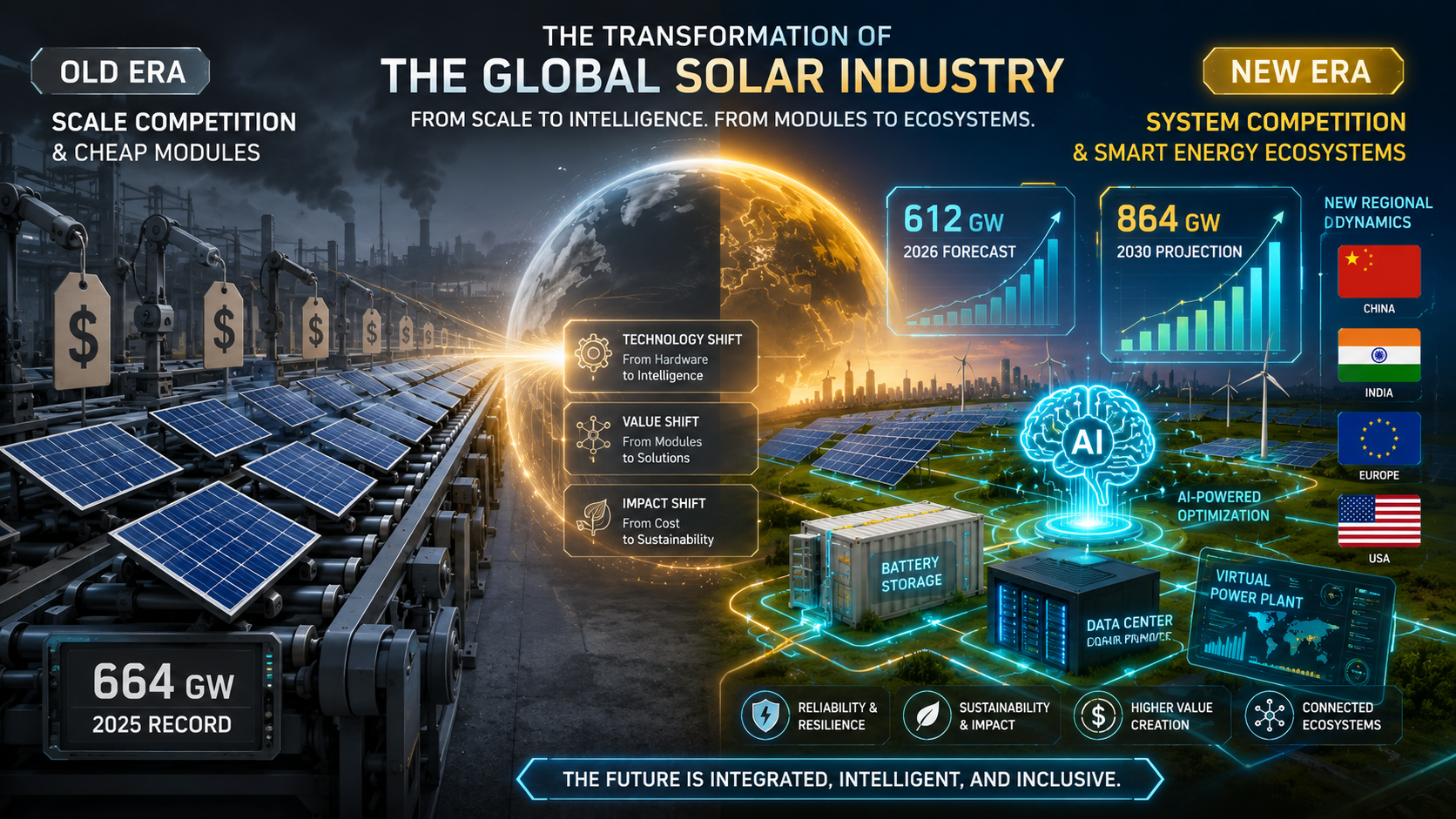
According to the reputable Global Solar Market Outlook 2026-2030 report published by SolarPower Europe, the world succeeded in installing 664 GW of new solar capacity—a record that once again confirmed solar’s 77% share of all renewable energy additions. Solar power generation reached 2,778 TWh, covering about 9% of global electricity demand, and the global solar fleet surpassed the 3 TW mark in early 2026—a capacity that tripled in just four years. But this unprecedented success has also marked the end of one era and the beginning of another.
Part One: Record-breaking in 2025 and forecast of temporary decline in 2026
China, with 382 GW installed, remained the main engine of global solar growth, accounting for 57% of total new capacity. India, with 49% growth and 45.7 GW installed, overtook the United States to become the world’s second-largest solar market. The European Union, with 67.2 GW, ranked third but experienced near-zero growth. However, this heavy concentration on China has led to an important forecast. Policy changes in China are expected to reduce its solar installations by 24%, and as a result, for the first time in over two decades, the global solar market is projected to decline by 8% in 2026, reaching 612 GW. Although this decline is temporary, and growth is expected to resume from 2027, reaching about 864 GW per year by 2030, this turning point sends a clear message: the era of “mere quantitative development” is over, and now quality, integration, and value creation take precedence.
Part Two: Paradigm shift from “panel seller” to “integrated solution provider”
Signs of this paradigm shift can be clearly seen in two key events of 2026. The SNEC 2026 International Exhibition in Shanghai, the world’s largest solar industry gathering, witnessed a structural transformation: for the first time, the number of halls dedicated to energy storage (6 halls) surpassed those for solar panels (4 halls). Industry giants like Longi, JinkoSolar, and Trina Solar no longer simply display panels but present “integrated solar-storage-smart management systems” as their core products. Longi, with its “LONGi ONE” strategy, explicitly announced its transition from a panel manufacturer to a complete energy solution provider. The same transformation was repeated at Intersolar Europe 2026 in Munich, where storage and integrated solutions became the main focus, and Chinese companies, with broader product portfolios and hybrid system displays, solidified their dominance.
Part Three: Artificial intelligence, storage, and “system-centricity”—the three pillars of the future industry
The three main driving forces behind this transformation are: First, “energy storage,” which has become an unavoidable necessity for grid stabilization and value enhancement, shifting from an add-on to the core of projects. The phenomenon of “negative electricity prices” during peak solar generation hours in Europe and parts of China is no longer an exception, and storage is the solution. Second, “artificial intelligence,” which has evolved from a fantasy concept to an operational tool for consumption optimization, grid management, and accurate electricity price forecasting. Third, “system-centricity”—moving from competition over price per watt of panels to competition over the total value of a system over its 25-year lifespan. These developments are also leading to the formation of new regional ecosystems; the US with its Inflation Reduction Act, India with production incentives, and Europe with its industrial regulations are all seeking to create more independent supply chains, while Chinese players are shifting their strategy from pure exports to investment and industrial partnerships in target countries.
Conclusion: The message for Iran
For Iran and leading companies like Energy Gostar Horan Payah, these global developments bring both a strategic opportunity and a major lesson. In a world where “selling panels” is no longer enough and real value lies in providing “integrated and intelligent systems,” Iranian companies must also start designing projects that have storage, smart management, and grid compatibility at their core. Collaboration with leading global companies and the application of state-of-the-art knowledge in integrated systems can solidify Iran’s position in the region’s competitive clean energy market. The new era of the solar industry is the era of “value creation,” and those who grasp this shift will be the winners of the future.
