
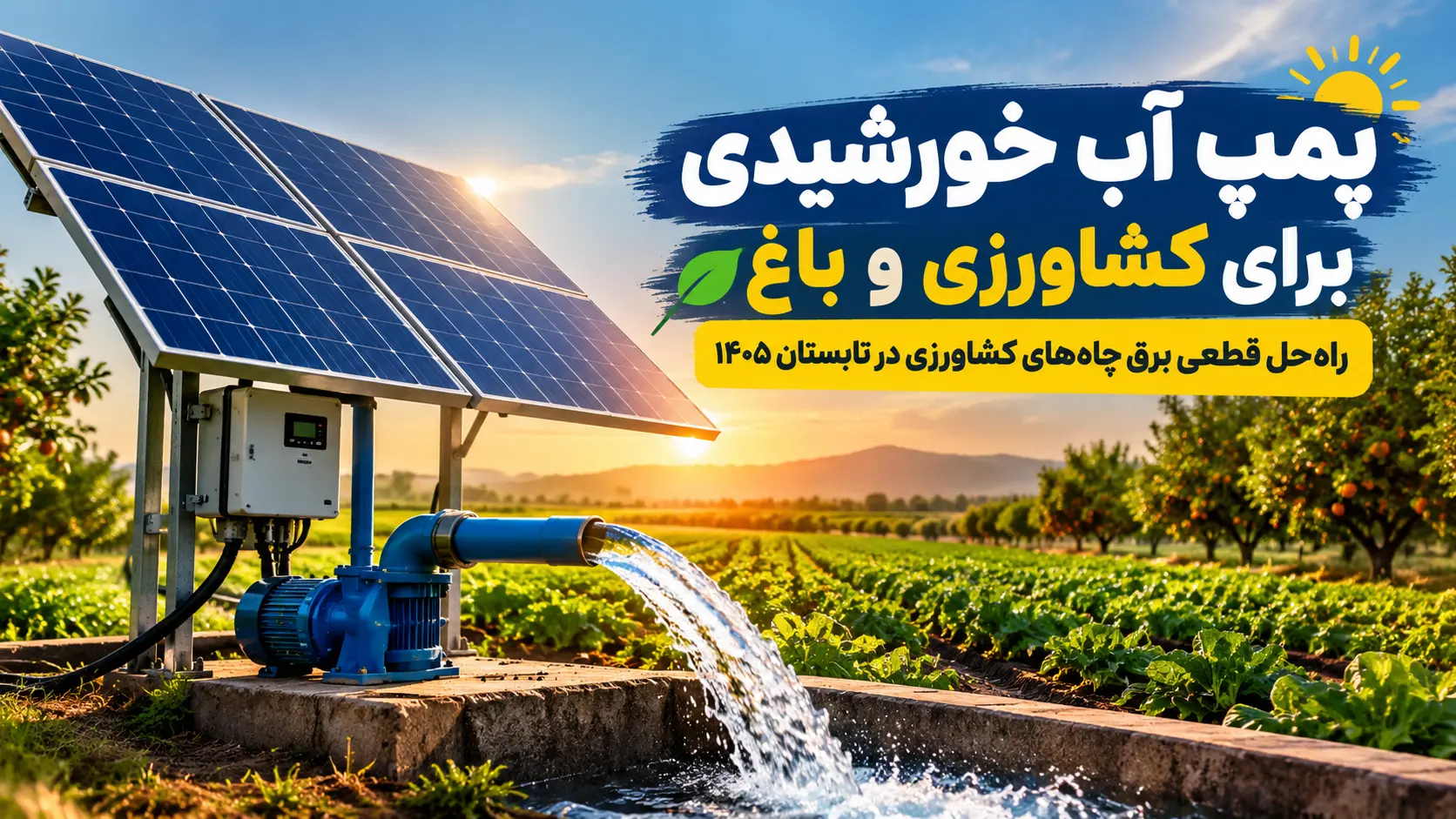
Short Answer: In 1405, the government announced that farmers who install solar power plants equivalent to 80% of the demand capacity of their agricultural water pumps will be exempt from power outages during summer peak consumption periods and can sell any surplus electricity on the energy exchange. This is an unprecedented economic and operational opportunity for farmers.
What is the Problem and Why Is a Solar Solution Urgent?
Summer power cuts to agricultural water wells have become a recurring crisis for years. In 1405, the Ministry of Energy implemented stricter regulations for managing the load on agricultural water pumps. For farmers whose irrigation depends on well pumps powered by electricity, every hour of power outage can mean irreparable losses. Solar pumps eliminate this dependency entirely.
Power Outage Exemption: How Does the 80% Condition Work?
The Deputy of Electricity and Energy at the Ministry of Energy has clearly stated: “Farmers who install solar power plants equivalent to 80% of the demand capacity of their agricultural water pumps will be exempt from power outages during summer peak consumption periods under the framework of the load management program.” In simple terms, if your pump’s power capacity is 10 kilowatts, you must install a solar system of at least 8 kilowatts to remain safe from summer outages. Typical capacities for this purpose are noted as 50 to 100 kilowatts for land adjacent to wells.
Cost and Return on Investment
The cost of a solar pump system depends on its capacity and equipment brand. For a small 2-kilowatt system (suitable for gardens or shallow wells), the cost of panels and accessories is estimated at 50 to 60 million tomans, and the cost of a solar floating pump is approximately 80 to 100 million tomans. For larger agricultural systems, pricing is calculated based on the required output kilowatts of the pump.
The main economic benefit lies in eliminating diesel fuel costs and recurring maintenance expenses for diesel pumps. In addition, with the power outage exemption, your crops receive sufficient water during peak heat, improving both performance and quality. If you generate surplus electricity, you can sell it on the Green Board of the Energy Exchange and generate additional income.
Practical Steps for Farmers
First, obtain your pump’s capacity (demand) from your local electricity authority. Then consult with experts at energyghp.com to design a system that covers at least 80% of this capacity. Choosing high-quality panels and suitable inverters ensures the system’s stable performance in future years and full legal exemption from power outages.
