
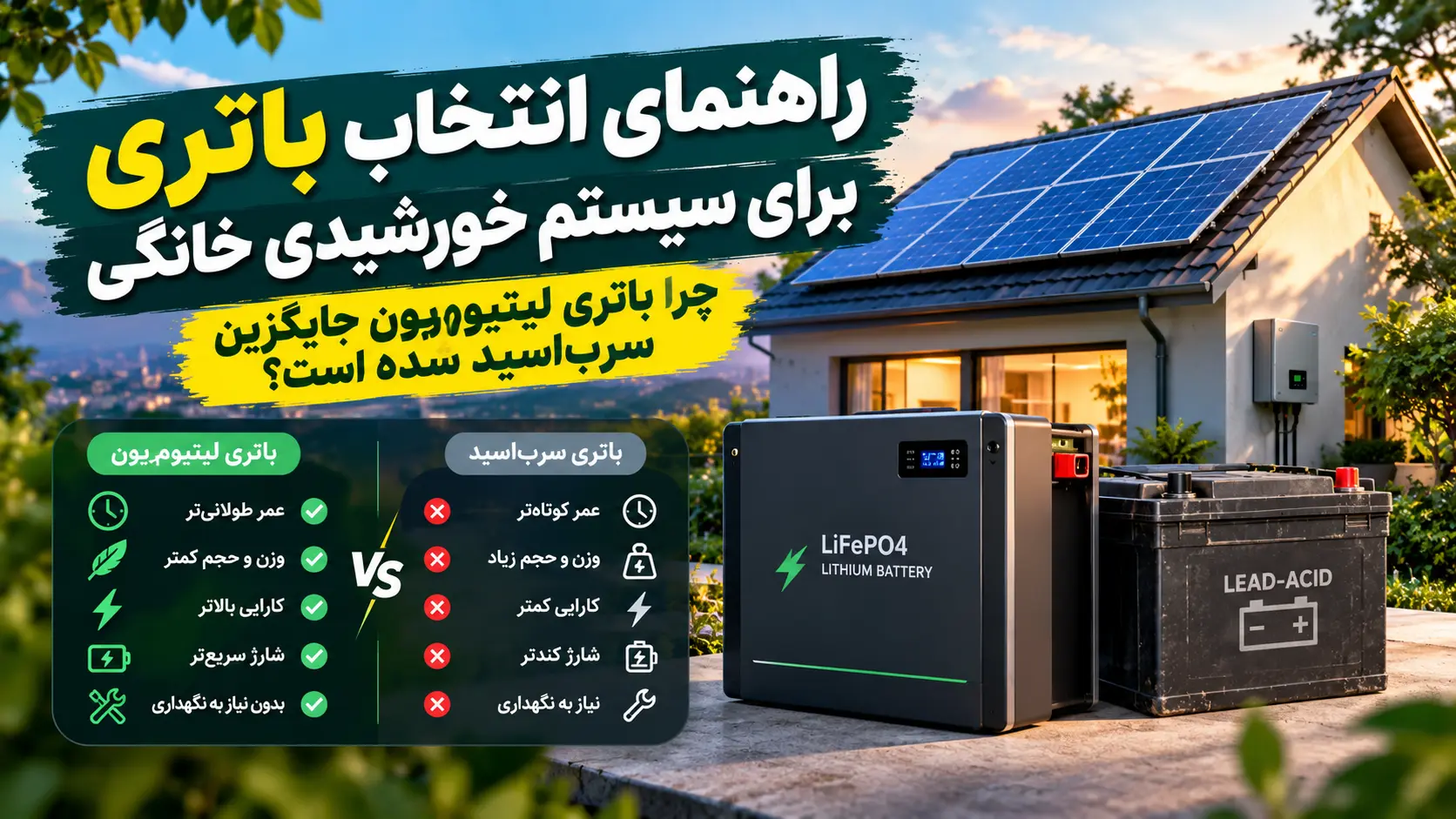
Short Answer: Given Iran’s climatic conditions and considering the total lifecycle cost (not just the initial price), Lithium Iron Phosphate (LFP) batteries are the superior choice for residential solar systems in 2025, due to their lifespan exceeding 6,000 cycles, usable depth of discharge of 80–90%, and ability to withstand temperatures up to 60°C.
Why is comparing batteries important?
Solar panels only generate electricity during the day. If you want to use this electricity at night or during grid outages, you need a battery. Choosing the wrong battery can jeopardize your entire investment, since batteries are typically the most expensive and shortest-lived component in an off-grid or hybrid system.
Technical and Economic Comparison of Lead-Acid and Lithium-Ion Batteries
Lead-Acid Battery (FLA/AGM/Gel): It has a lower initial cost, but its useful lifespan is at best 3 to 7 years. Its most significant drawback is the limited depth of discharge (DoD); you should generally not discharge more than 50% of the battery’s capacity, or else its lifespan will drastically decrease. In the hot southern regions of Iran, lead-acid batteries perform noticeably worse and require regular maintenance and watering.
Lithium-Ion Battery (LFP): It has a higher initial cost (a 5 kWh LFP battery in Iran’s market costs approximately 239 to 250 million Iranian Rials), but its lifespan exceeds 6,000 cycles and in practice lasts more than 10 years. Its usable depth of discharge is 80–90%, meaning you can utilize more electricity from its nominal capacity. It can withstand temperatures up to 60°C, and its internal Battery Management System (BMS) protects it from improper charging and discharging.
Calculating Real Cost: Why is Lithium-Ion More Economical?
Suppose you need 5 kWh of storage capacity. A lead-acid battery with a 50% depth of discharge would need to have a capacity of 10 kWh to meet this requirement. If we assume each kWh of lead-acid battery costs around 15 million Iranian Rials, the initial cost would be 150 million Iranian Rials. However, this battery would need to be replaced after 3 to 5 years. In contrast, a 5 kWh LFP battery with an 80% depth of discharge can meet the same need and lasts more than 10 years. When dividing the initial cost by the number of years of lifespan, the annual cost of LFP is significantly lower than that of lead-acid.
Final Recommendation for Iranian Buyers
If you have a limited budget and your system is small (e.g., only for lighting and a refrigerator in moderate climates), AGM lead-acid may be a good starting point. However, if you’re seeking high reliability, long lifespan, and stable performance in Iran’s heat—especially for your main home or villa—investing in an LFP battery is a smarter choice. The team at energyghp.com can calculate your exact battery capacity needed based on your daily and nightly consumption and recommend the best option for you.
