
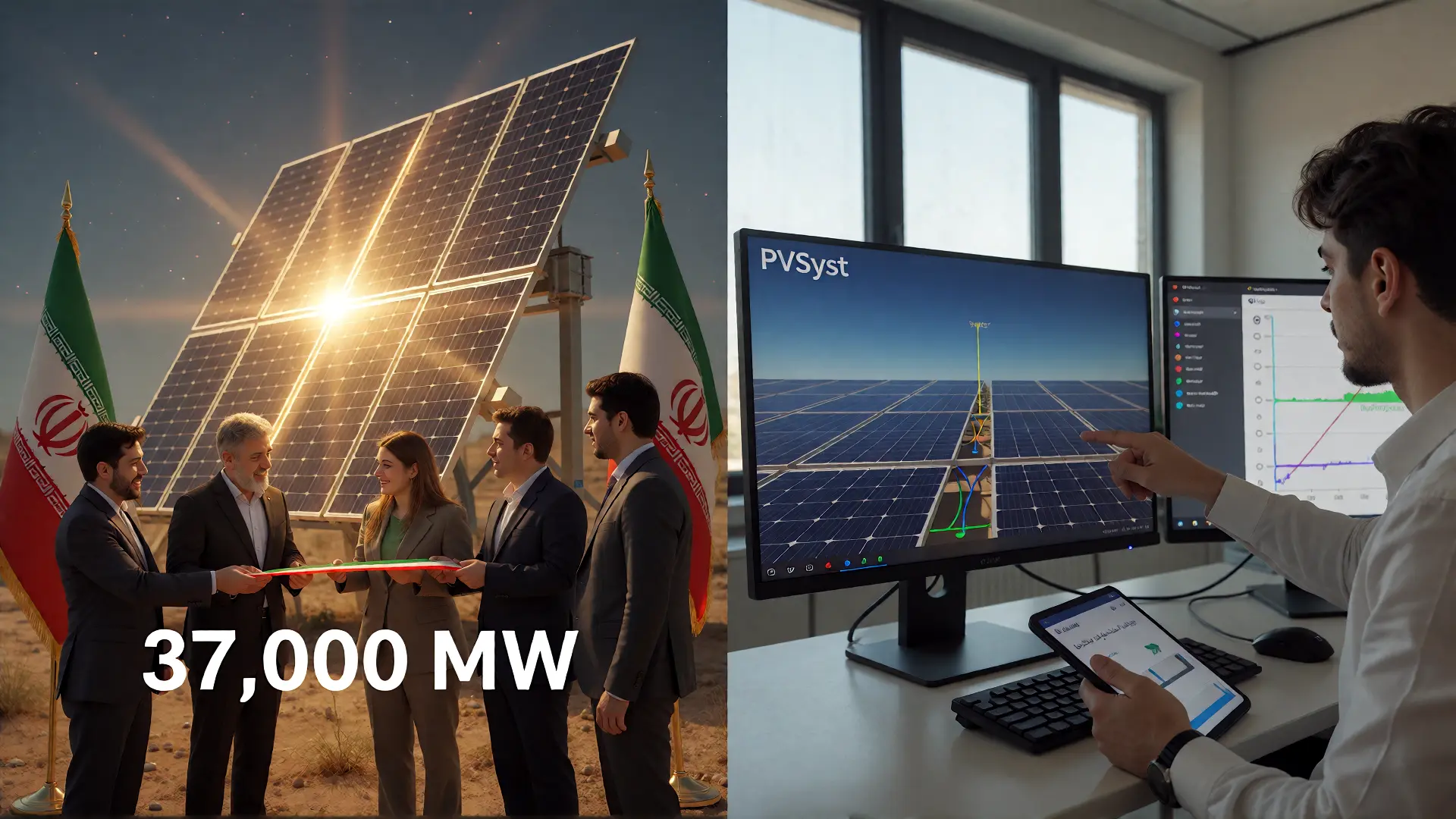
Iran’s solar energy industry has regained momentum in recent days. On one hand, the news of land allocation for the production of 37,000 megawatts of solar electricity and the inauguration of the 95-megawatt Shams Abad Industrial Park power plant in the presence of the President indicate the government’s serious determination to develop clean energy. On the other hand, the unveiling of the first solar project fund on the Energy Exchange has opened new horizons for public participation in this field. These developments, like a picture of a bright tomorrow, lie ahead of investors and activists in this field. In the following, while reviewing this news, we introduce the most important specialized software that every professional expert needs for the design and simulation of solar power plants.
Part One: Important News of Iran’s Solar Industry
In news that can be considered a turning point for Iran’s solar revolution, the head of the country’s Land Affairs Organization announced that sufficient land has so far been provided to operators for the creation of more than 37,000 megawatts of solar electricity generation capacity. Over the past two years, the Ministry of Agriculture-Jihad has allocated about 57,000 hectares of national and government lands for this purpose, and with full utilization of this capacity, a significant portion of the country’s energy deficit can be compensated through clean energies.
In this regard, yesterday the 95-megawatt solar power plant of Shams Abad Industrial Park was inaugurated in the presence of the President. This complex includes two power plants named “Qaed Shahid” (63 megawatts) and “Shohadaye Lamerd” (32 megawatts) and will supply part of the electricity needed by the industries of this park from clean energy. Mohammad Sadeq Motamedian, the Governor of Tehran, at this ceremony, referring to the fact that the capacity of solar power plants in Tehran Province has reached about 400 megawatts, emphasized that this figure has increased 20-fold over nearly the past two years.
Simultaneously with these quantitative leaps, new financial instruments have also been designed to attract investment. The ceremony for the beginning of the subscription of the first solar electricity project fund was held in the presence of the Minister of Energy. Abbas Aliabadi, the Minister of Energy, at this ceremony, referring to the successful experience of the Parand Power Plant project fund, emphasized the necessity of using people’s small capital for the development of solar energy and announced full readiness to support this path.
Part Two: Introduction of Specialized Software of the Solar Industry
With the expansion of solar projects, the need for precise tools for design and simulation is felt more than ever. In this regard, two software programs, PVsyst and PVcase, are recognized as the most widely used and standard tools in the world, and today most solar projects are designed using these two software programs.
PVsyst software, which is known as the gold standard of the solar industry, is a comprehensive tool for the simulation and design of all types of grid-connected and off-grid power plants. This software, which is used by thousands of engineers around the world, provides the possibility of accurate simulation of system performance by taking into account various climatic factors. One of the main reasons for PVsyst’s popularity is its ability to produce reliable and “bankable” reports, which are considered essential for obtaining financial facilities and securing capital for large projects (above 5 megawatts). Banks and international financial institutions usually accept the simulation reports of this software as a reference. The new version of this software, PVsyst 6.8, has recently been released.
Alongside PVsyst, PVcase software has a special place as a specialized tool for the design and optimization of executive maps of solar power plants in the AutoCAD environment. This powerful plugin, by offering capabilities such as three-dimensional design, accurate calculation of distances and shading, cable sizing, and preparation of complete executive documents, greatly facilitates the engineering design process. PVcase is particularly useful for large-scale projects and ground-mounted power plants that require precise layout and surveying outputs.
In addition to these two, other software programs also exist in the market. HelioScope is one of the popular alternatives to PVsyst, known for its web-based user interface and high speed in designing solar farms (especially projects above 1 megawatt). Aurora Solar software is also a suitable option for designing residential and commercial projects. Also, SAM (System Advisor Model) software, developed by the U.S. National Renewable Energy Laboratory (NREL), is a free and powerful tool for simulating the performance and financial analysis of renewable energy projects that offers deeper financial modeling than PVsyst. In the European market, PV*SOL software, with a special focus on battery simulation and storage systems and compliance with German regulations, has its own fans.
Conclusion: Preparation for the Future
The news of these days of Iran’s solar industry indicates an unprecedented leap in capacity building and diversity of financing tools. Land allocation for 37,000 megawatts, inauguration of new power plants, and the launch of project funds all promise a bright future. In the meantime, mastery of specialized software such as PVsyst and PVcase has become an undeniable necessity for every expert and company that intends to play an effective role in this path. The job market for specialists proficient in these software programs is very broad both inside and outside the country. Leading companies such as Energy Gostar Hooran Paya, by using these up-to-date world tools, can carry out the design and execution of projects with the highest precision and quality and play a key role in advancing the national goals of clean energy. The new era of solar energy in Iran, relying on technical knowledge and modern tools, has already begun.
