
The question “How many years does it take for a solar power plant to break even?” seems simple, but its answer depends heavily on the plant’s capacity, the guaranteed purchase rate, construction costs, and operational conditions. In 2023 (1405 in the Iranian calendar), with the announcement of new guaranteed purchase rates—experiencing a 47 to 53 percent increase—the capital recovery calculations have undergone fundamental changes. In this analysis, based on official data from SATBA and the Ministry of Energy, we calculate the capital recovery period for different capacities ranging from 5 kilowatts to 1 megawatt and examine the factors that can alter these calculations.
New Guaranteed Purchase Rates in 2023 (1405); A Leap That Changed the Equations
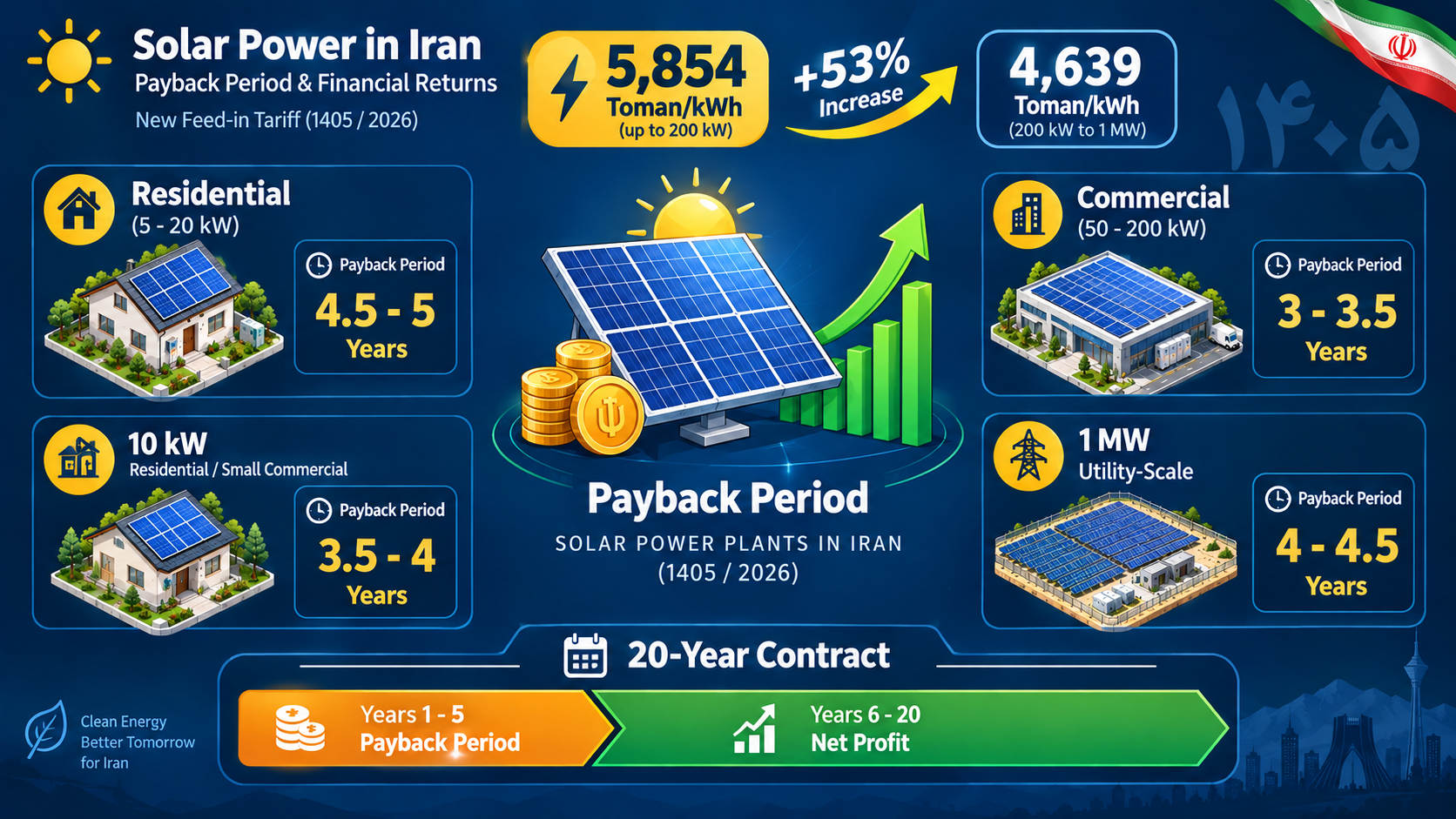
According to the Ministry of Energy’s announcement on March 10, 2023 (1405), the base guaranteed purchase rate for electricity from solar power plants is as follows: plants with a capacity of up to 200 kilowatts receive a rate of 58,540 rials (equivalent to 5,854 tomans) per kilowatt-hour, representing a 53 percent increase compared to the previous year. Plants equipped with battery storage receive a higher rate of 91,169 rials (approximately 9,117 tomans). For plants with a capacity of between 200 kilowatts and 1 megawatt, the rate is set at 46,386 rials (equivalent to 4,639 tomans), indicating a 47 percent increase .
This significant increase occurred amid conditions in which construction costs for power plants have also risen by approximately 20 percent due to customs changes and inflation . However, the key point is that income growth (50 percent) has outpaced cost growth (20 percent), and this gap has noticeably reduced the capital recovery period.
Capital Recovery Calculations for Different Capacities
5-kilowatt Plant; Popular Choice for Households
According to Zahra Olya, Director General of SATBA’s Economic Review Office, the estimated construction cost of a 5-kilowatt plant is currently around 350 to 400 million tomans . A 5-kilowatt plant can produce approximately 9,000 kilowatt-hours of electricity annually. At a rate of 5,854 tomans per kilowatt-hour, the plant’s first-year revenue will be approximately 52.7 million tomans.
Assuming a construction cost of 375 million tomans, the capital recovery period is estimated at around 7 years. However, this calculation does not consider the annual adjustment factor. Applying the annual adjustment, revenue in subsequent years increases, and the actual capital recovery period drops to 4.5 to 5 years .
10-kilowatt Plant; Optimal Balance Between Capacity and Capital
The estimated construction cost of a 10-kilowatt plant is approximately 240 to 380 million tomans . With an annual production of approximately 18,000 kilowatt-hours and a rate of 5,854 tomans, the plant’s first-year revenue will be approximately 105 million tomans. With a construction cost of 310 million tomans, the initial capital recovery period is approximately 3 years, which, considering the annual adjustment, becomes approximately 3.5 to 4 years in practice.
100-kilowatt Plant; Option for Businesses
The estimated construction cost of a 100-kilowatt plant is approximately 2 to 3 billion tomans . With an annual production of approximately 180,000 kilowatt-hours and a rate of 5,854 tomans, the plant’s first-year revenue will be approximately 1.05 billion tomans. With a construction cost of 2.5 billion tomans, the initial capital recovery period is approximately 2.4 years. This figure, when adjusted annually, becomes approximately 3 to 3.5 years.
1-megawatt Plant; Large-Scale Investment
The estimated construction cost of a 1-megawatt plant is approximately 3 to 3.5 billion tomans . With an annual production of approximately 1,800,000 kilowatt-hours and a rate of 4,639 tomans (the rate specific to capacities between 200 kilowatts and 1 megawatt), the plant’s first-year revenue will be approximately 8.35 billion tomans. With a construction cost of 3.25 billion tomans, the initial capital recovery period is approximately 3.9 years, which, when adjusted annually, reduces to approximately 4 to 4.5 years.
Factors Affecting the Capital Recovery Period
Annual Adjustment; The Engine Driving Revenue
The guaranteed purchase rate for solar electricity is adjusted annually in line with inflation and exchange rate indices . This adjustment, which has been particularly significant in recent years due to high inflation, protects the investor’s income stream against the depreciation of money. Without this adjustment, the capital recovery period would be significantly longer. With an annual inflation rate of 66 percent (according to the Central Statistical Organization’s announcement in June 2023 (1405) ), the adjustment of the solar electricity purchase rate is considered a vital advantage for investors.
Operational and Maintenance Costs
Capital recovery calculations typically do not consider annual operational and maintenance costs. These costs, which include panel cleaning, periodic inspections, and minor repairs, are generally estimated at 1 to 2 percent of the initial investment per year. For a 100-kilowatt plant, this annual amount will be approximately 25 to 50 million tomans, which is subtracted from net revenue.
Annual Decline in Panel Efficiency
Solar panels are typically sold with an 80 to 85 percent performance guarantee for 25 years. This means that panel efficiency gradually declines by approximately 0.5 to 0.8 percent annually. This decline should be considered in long-term calculations, although its impact on the initial capital recovery period is negligible.
Project Scheduling and Delay Risk
An important factor often overlooked in financial calculations is the risk of delay in commercial operation. According to the regulations announced, the approved rates apply to contracts for which the plant reaches commercial operation within a specified timeframe (maximum 15 months for solar projects). In case of delay, for the remaining contract period, the last approved base rate at the date of commercial operation commencement or the rate specified in the contract, whichever is lower, applies . This means that construction delays can cause investors to lose the best rate and extend the capital recovery period.
Summary; Actual Capital Recovery in 2023 (1405)
With the new guaranteed purchase rates in 2023 (1405), the capital recovery period for solar power plants in Iran has noticeably decreased. For small household plants (5 to 10 kilowatts), the capital recovery period is estimated at approximately 3.5 to 5 years . For medium-sized plants (100 kilowatts), this period reduces to 3 to 3.5 years, and for large-scale plants (1 megawatt), it will be approximately 4 to 4.5 years.
These capital recovery periods, considering the long useful life of solar panels (25 years) and the 20-year guaranteed purchase contract, mean over 15 years of net income for investors. In conditions where the country’s annual inflation exceeds 60 percent, solar power plants have become a resilient investment against inflation and a revenue-generating asset with adjusted income, securing a special place in household and business investment portfolios. However, precise calculations for each specific project require consideration of local conditions, equipment quality, and additional costs, and investors must conduct detailed feasibility studies before any action.
